How artists are responding to climate change
In the summer of 2025, Edward Burtynsky photographed the aftermath of the Los Angeles wildfires from the air. The images - charred hillsides, erased neighbourhoods, the geometry of destruction visible only from above - were shown publicly for the first time as part of his retrospective at the International Center of Photography in New York, timed deliberately to coincide with Climate Week NYC in September.
Burtynsky has been doing this for four decades. Flying over open-pit copper mines in Arizona, oil refineries in Azerbaijan, rice terraces in China. The images are enormous, formally beautiful, and deeply unsettling - they draw you in before you fully understand what you are being asked to see. As artist Neil Campbell said at a recent gallery event in Vancouver: very few artists now make work that carries a true sense of awe. Burtynsky’s photographs are among the exceptions.
But Burtynsky is one point on a much wider spectrum. Across painting, installation, photography, and sculpture, a generation of artists is working directly with the climate crisis - not as a backdrop, but as the subject itself. Their responses are varied, politically charged, commercially significant, and, in some cases, quietly revolutionary.
The photographers who made the scale visible
Burtynsky’s method is deliberate: make the scale of industrial transformation so large and so beautiful that the viewer cannot look away. His retrospective The Great Acceleration - the term scientists use for the exponential rise of human impact on the planet from the mid-20th century onwards - presented more than 70 photographs spanning mines, oil fields, water systems, and deforestation across five continents. It was his first major solo institutional show in New York in over twenty years.
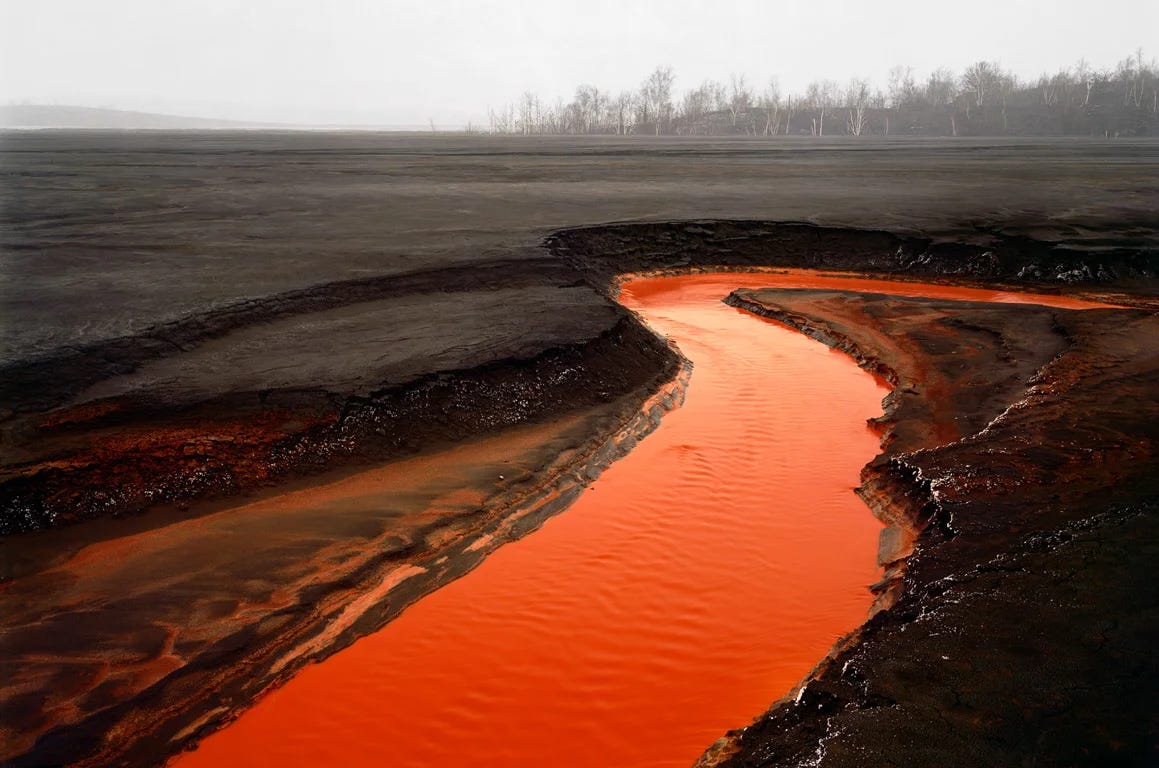
His current project, Mining for the Future, turns its lens on the Democratic Republic of Congo’s copper mines. To reach net zero on climate change, the world needs vast quantities of lithium, copper, and cobalt. Burtynsky photographs the source: independent miners sifting through dry tailings for trace amounts of cobalt in conditions that are both ecologically devastating and economically desperate. The contradiction - that the materials for the green transition come from landscapes that look anything but green - is precisely his subject.
The installations that brought the melting to your door
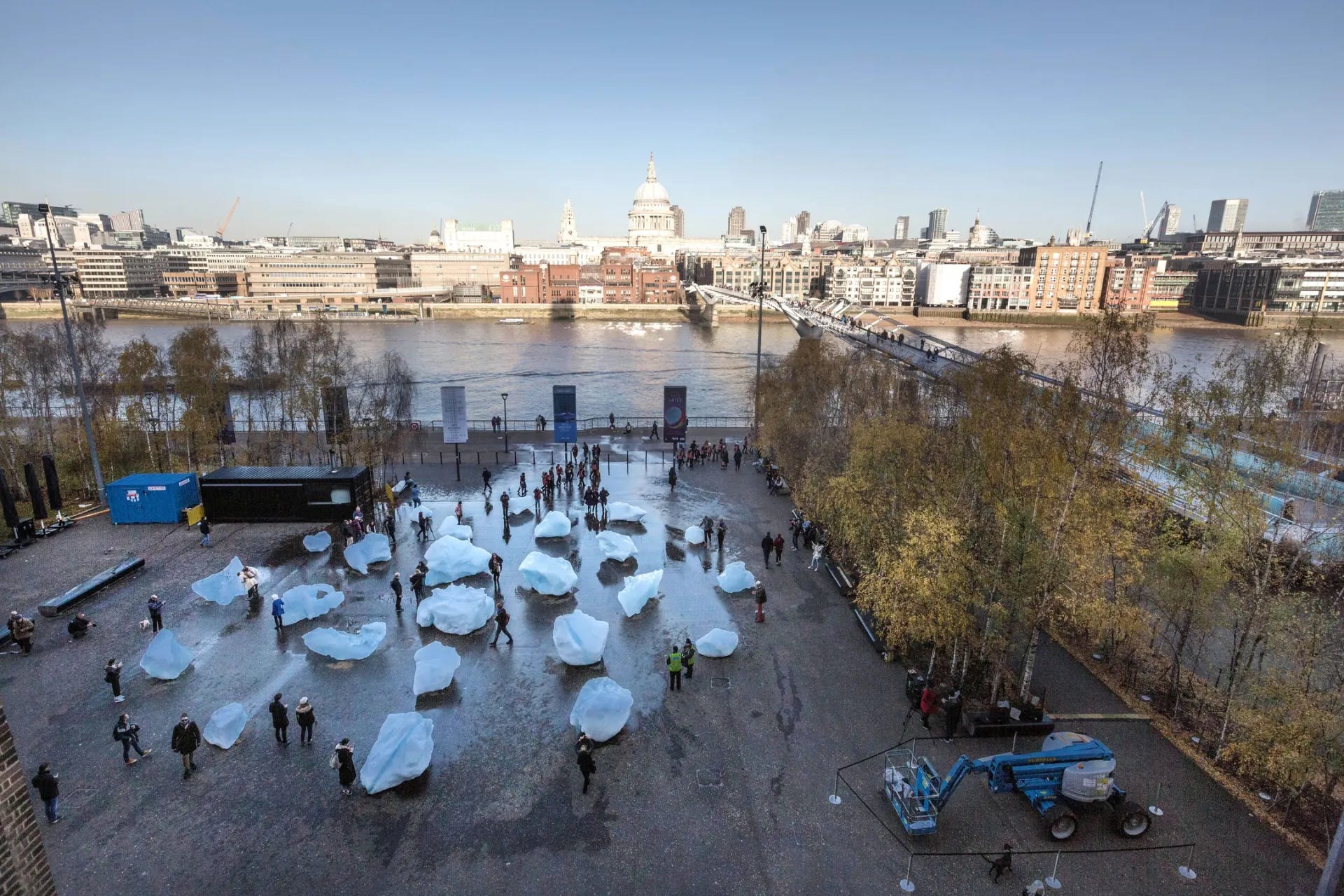
Olafur Eliasson’s approach is more direct. In 2018, he placed 24 blocks of glacial ice from Greenland on the steps of Tate Modern and outside the Panthéon in Paris, allowing them to melt in public. The installation was called Ice Watch. It has since appeared in London, Paris, Copenhagen, New York, and Hong Kong.
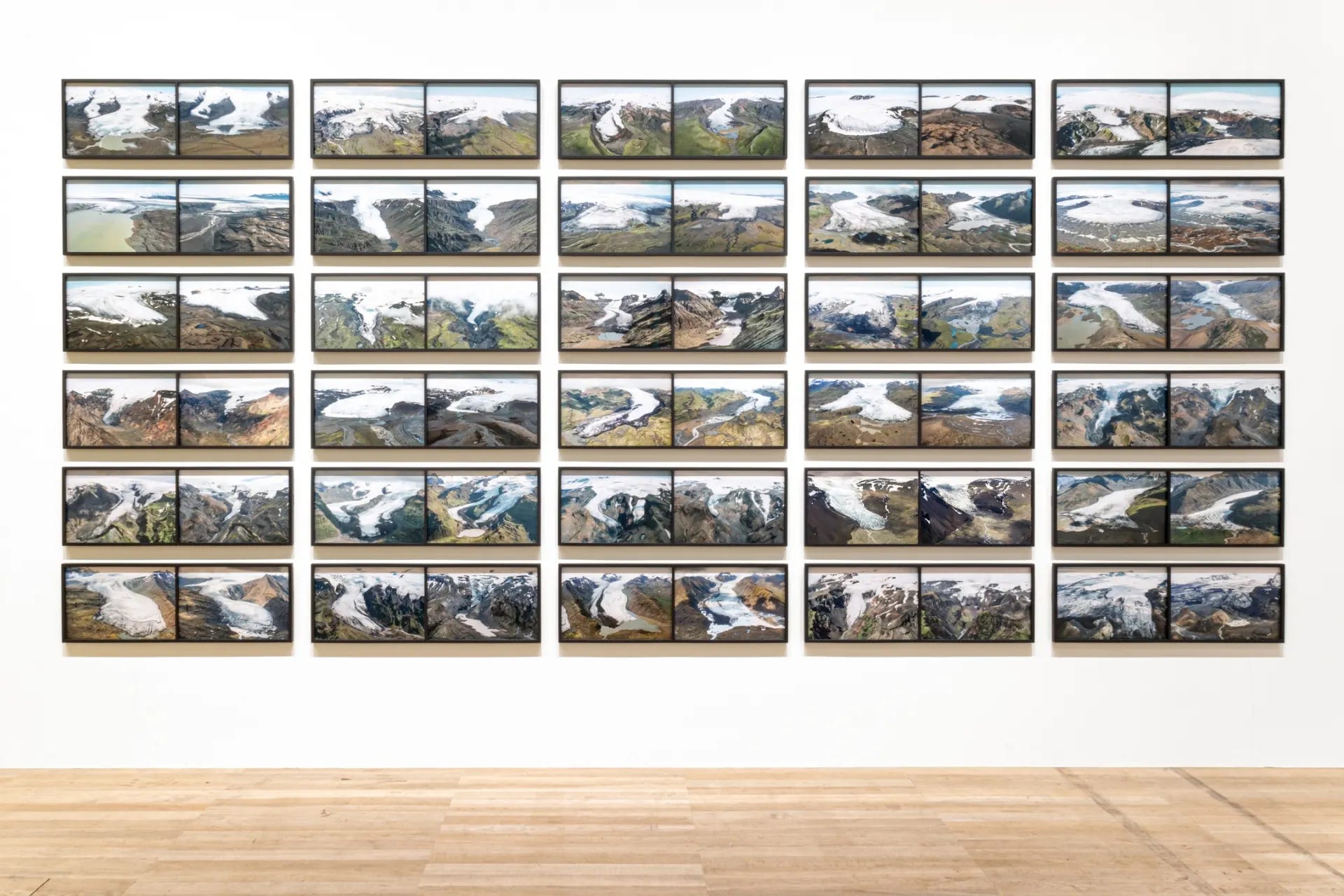
There is nothing metaphorical about it. The ice is real, the melting is real, and the pool of meltwater forming on the pavement around each block is a literal measurement of time passing and ice disappearing. Eliasson, Icelandic-Danish, has been photographing glaciers since 1999. His series The Glacier Melt Series 1999/2019 pairs images of the same glaciers taken two decades apart. The recession is visible, specific, and documented.
In 2019, Eliasson was appointed goodwill ambassador for renewable energy and climate action by the United Nations Development Programme - a formal recognition that art was doing work that policy briefings and scientific reports were not. He has said: “Every glacier lost reflects our inaction. Every glacier saved will be a testament to the action taken in the face of the climate emergency.”
His work is also commercially significant. Eliasson’s studio, which employs more than 100 people, operates at the intersection of art, architecture, and environmental research. His installations have entered major institutional collections worldwide and command prices that reflect both their scale and their cultural urgency.
The painters working with ecological grief
Not every response to climate change is monumental in scale. Some of the most affecting work is intimate, made in studios, responding to what the artist can see and touch and grieve.
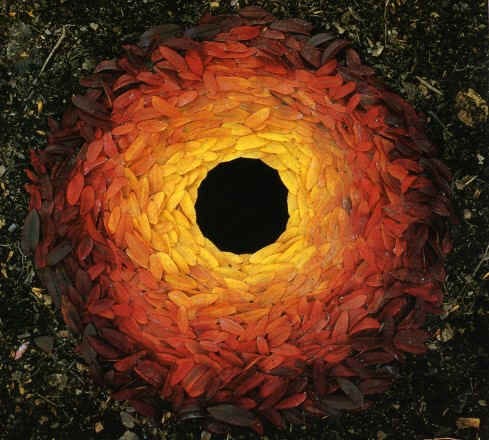
British sculptor and environmental artist Andy Goldsworthy has spent four decades making site-specific works from the materials he finds in the landscape - leaves, ice, stones, fallen branches, icicles. He does not preach. His work chronicles instead: the life cycle of materials in the natural world, the way things decay and transform, the passage of seasons through a specific place over time. He photographs everything, tracking what changes and what disappears.
Julie Heffernan, an American painter, has made a series called When the Water Rises - large figurative paintings that “create alternative habitats in response to environmental disaster and planetary excess.” Her paintings place human figures inside ecosystems that are flooded, overwhelmed, or in the process of collapse. They are painterly in the traditional sense - technically complex, emotionally layered - but their subject matter is urgently contemporary.
John Akomfrah, British of Ghanaian descent, works in film and video installation. His six-channel installation Purple (2017) weaves together archive footage and newly filmed sequences to address climate change across multiple timescales and geographies. It is in the collection of the British Council and has been shown internationally. His work was included in the British Pavilion at the Venice Biennale 2024.
The climate crisis is reshaping what collectors buy, what galleries show, and what earns critical attention. If your own work engages with landscape, nature, or environment, understanding its market context matters.
What the market shows
Collectors are responding. The Art Basel and UBS Global Art Market Report 2026 confirmed what gallery professionals have been observing for several years: social impact has become a major factor in art acquisition. Collectors are actively seeking artists who address climate change, identity, and social issues. Sustainability is now influencing not just what collectors buy, but how art is produced, shipped, and sold.
The Art Collecting Trends 2026 report from One Art Nation noted that this shift is most pronounced among collectors aged 30-45, who now represent nearly one-third of all global high-net-worth art spending and show the highest willingness to acquire works by emerging artists engaging with environmental themes.
This is a meaningful market development for emerging painters working with landscape, nature, or ecological themes. The environmental art category is no longer a niche. It has become one of the primary lenses through which a significant and growing segment of the collector base evaluates work - not just whether the painting is beautiful, but whether it is in conversation with the moment.
The most commercially successful artists working in this space - Burtynsky, Eliasson, Goldsworthy - have all built their markets over decades through consistent, specific, documented engagement with environmental subjects. None of them pivoted to the topic when it became fashionable. The longevity of their commitment is itself a value signal.
The ethical question the work raises
There is a tension that runs through climate art that is worth naming directly. The artists making the most visible work about environmental destruction are often doing so using significant resources - international travel, large-scale fabrication, institutional platforms. Burtynsky flies over mines in private aircraft. Eliasson’s studio has a significant carbon footprint. The contradiction between the message and the means of delivery is one the art world is actively wrestling with.
Some artists have responded by making sustainability central to their material practice. Andy Goldsworthy uses only what he finds. Others, like the collective Futurefarmers, work with seed libraries and soil research as both practice and advocacy. The question of whether art about climate change can and should operate differently from other art - in its materials, its travel, its exhibition logistics - is now a live debate inside galleries and institutions.
For painters specifically, the question takes a different form. Oil paint has a long ecological history - the extraction of pigments, the chemistry of solvents, the longevity of the materials themselves in museum collections. Artists working with traditional media are increasingly documenting their material choices, researching sustainable pigment alternatives, and considering the full life cycle of their work.
None of this resolves the tension. But the artists who engage with it honestly - who make their practice a form of the argument rather than separate from it - are the ones whose work tends to carry the most weight.
Why this matters now
In 2025, Agora Gallery’s analysis of contemporary market data found that sustainability and climate awareness had moved from “powerful undercurrents” to “central drivers” of the art scene. This is not a passing moment. The structural forces driving it - a generational shift in collecting demographics, institutional commitment to environmental programming, the visibility of climate events in the news cycle - are all deepening, not receding.
For artists at any career stage, this creates both context and opportunity. Context: the work you make about landscape, nature, ecology, or environmental loss is being made into a market that is actively seeking it, not tolerating it. Opportunity: the artists who have built long-term, specific, credible engagement with these subjects - not those who have adopted them as a trend - are the ones whose reputations and prices are growing most reliably.
Art cannot solve the climate crisis. But it can make visible what statistics cannot, and create the kind of emotional reckoning that precedes political will. Burtynsky described his approach to National Geographic as imagining himself “an alien, sent to Earth by some other intelligence to see what we’re doing to the planet.” That distance - seeing the familiar as strange, the normalised as devastating - is what the best work in this category achieves.
Priceyourpainting uses current market data to give you a price range for your specific painting - including work that engages with landscape, nature, and the natural world.
References
Edward Burtynsky: The Great Acceleration - International Center of Photography, New York, June-September 2025. icp.org
Edward Burtynsky’s new photo exhibit shows all the beautiful, terrifying ways humans change the Earth - National Geographic, June 2025. nationalgeographic.com
A week with Edward Burtynsky - Paul Kyle Gallery, Vancouver, May 2026. paulkylegallery.com
Contemporary artists bring the realities of climate change into focus - Artsy, April 2025. artsy.net
Art Basel and UBS Global Art Market Report 2026 - Arts Economics / Dr. Clare McAndrew. artbasel.com
Art collecting in 2026: trends of successful collectors - One Art Nation, May 2026. oneartnation.com
Top art trends for 2026 - Agora Gallery. agora-gallery.com
11 visual artists taking on the climate crisis - Climate Reality Project. climaterealityproject.org
Made with love by artists, for artists.
Stay connected with us on Instagram for more artist stories and market updates.