How artists are responding to war: censorship, destroyed works and survival
In 2026, the director of Sudan’s antiquities authority reported that more than 60% of the National Museum of Sudan’s holdings had been looted during the country’s civil war. When a museum is emptied, a culture loses part of its memory. Artists are often the ones who rebuild it.
This is part four of our series on how artists respond to war. Part one looked at how artists document, resist and survive conflict. Part two looked at the market for conflict art. Part three told the stories of four painters working through war. This piece asks what happens when the record itself is under attack.
When the archive is the target
The National Museum of Sudan in Khartoum was taken over by Rapid Support Forces fighters after heavy fighting in 2023, and video from inside showed soldiers opening display cases. In March 2026, USA Art News reported that the head of the country’s antiquities authority, Ghalia Garelnabi (also transliterated Jar Al-Nabi), said more than 60% of its holdings had been looted. Earlier, after the paramilitary force was pushed out of Khartoum in March 2025, she had made a separate and more severe claim: that 90% of the holdings had been destroyed. These are statements by the Sudanese authorities, and independent verification inside a war zone is limited. What is not in dispute is that the losses are very large.
Sudan is not alone. In Afghanistan, the Kabul Museum lost at least 70% of its display and storage items to looting over two decades of war, according to a January 2002 report by The New Humanitarian. Then, on 26 February 2001, the Taliban leader Mullah Muhammad Omar ordered the destruction of all statues in the country. From 2 March 2001, the Buddhas of Bamiyan, carved into a cliff around 600 CE and carbon-dated to the sixth and seventh centuries, were blown apart over several weeks. They had stood for roughly 1,400 years.
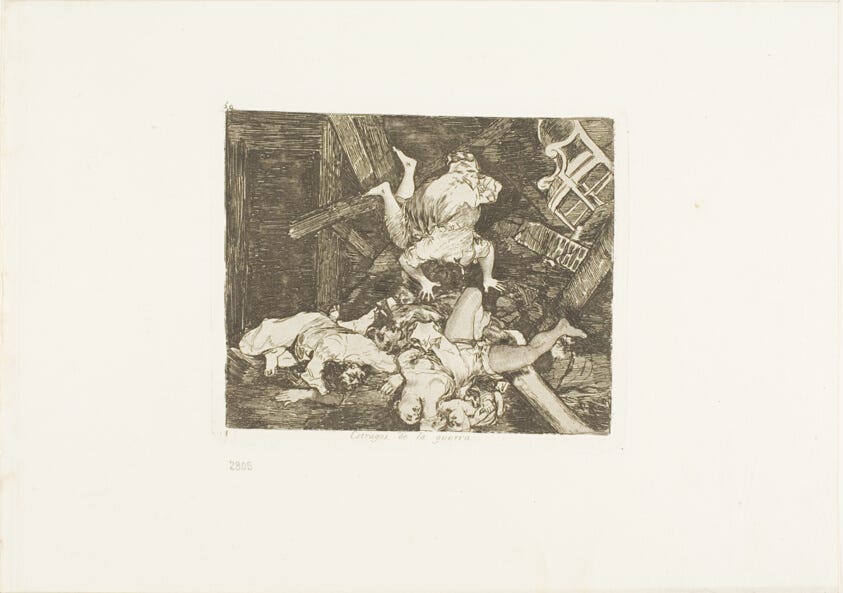
Artists have recorded destruction like this for centuries. Francisco Goya’s etching “Ravages of war” is plate 30 of The Disasters of War, a series he made from about 1810 about war in Spain. The Art Institute of Chicago dates this plate to 1810/11 and records that the series was first published in 1863, decades after Goya’s death in 1828. Records made by artists can outlast the moment, and sometimes wait a long time to be seen.
Making art when the evidence is gone
When photographs, archives and objects are destroyed, artists carry memory in other forms. Sarah Elawad, a British Sudanese artist, built her 2025 Plaza Commission at The Africa Center in Harlem, “When the War is Over”, around the tobe, the garment traditionally worn by Sudanese women. The title comes from a line by the poet Safia Elhillo: “When the war is over I will make space for my feelings.”
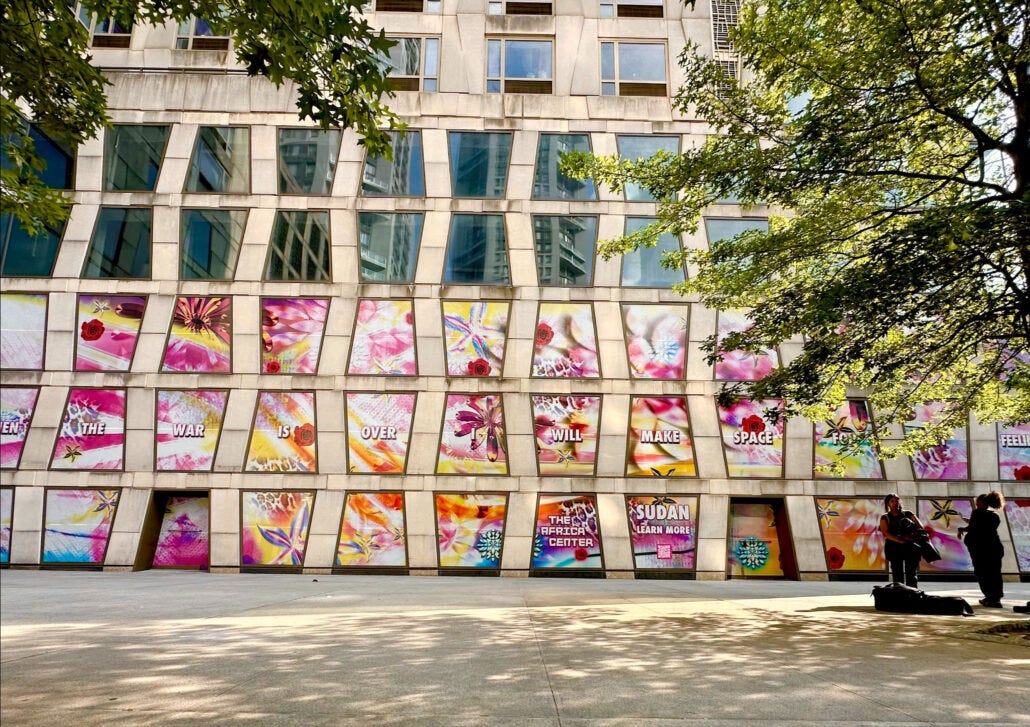
Elawad has described the tobe as “a marker of womanhood, identity, and cultural continuity.” Of the work’s purpose, she said: “Amid loss and upheaval, we rarely have space to grieve, to feel, or to simply be.” Rather than documenting atrocity, she gives viewers colour, pattern and movement. The installation debuted on 10 June 2025 and remained on view until May 2026.
This is a pattern worth recognising. Where documentary imagery is dangerous, or where the original objects no longer exist, symbolic and material work can carry what a photograph cannot.
Censorship as a current tool of war
Censorship is not only a feature of the past. During the 2026 Iran war, Israel’s military censor required reporters to submit footage and articles for review before publication, while Iran imposed near-total internet blackouts and moved traffic onto a restricted domestic network, according to reporting from Tech Policy Press (1 April 2026) and Reporters Without Borders (11 March 2026).
For visual artists, the risk is direct. Freemuse, which monitors artistic freedom worldwide, named Iran among the countries with intensifying crackdowns in its State of Artistic Freedom 2025 report, which covers 2024. The report also found that self-censorship has spread widely, even in democracies, as artists fear reprisals. Many keep working. The report quotes the ceramicist Nathalie Khayat: “Art is the opposite of war.”
When open protest is unsafe, artists tend to turn to allusion: images that can pass a censor but remain legible to those who share the experience. That is a reading of the pattern, not a rule, and we do not have data on how widespread it is.
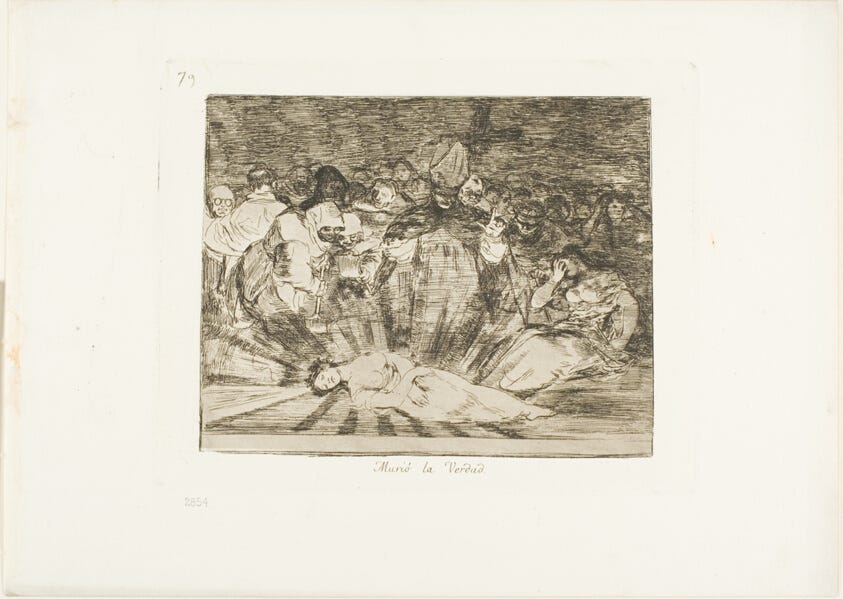
Goya gave plate 79 of the same series a title that fits this theme: “Truth has died” (1815/20).
Censorship far from the front line
Silencing does not only happen where the shooting is. The same Freemuse report found that artistic expression related to Gaza faced growing censorship, particularly in Germany and the United States. Its research director, Sara Whyatt, describes a year in which artists faced censorship, arrest and violence, and in which self-censorship spread even in democratic societies.
For an emerging painter, this has a practical meaning. A show can be cancelled, a gallery can quietly decline a subject, and an artist can decide not to paint something at all. None of that leaves a visible trace. It is one more reason to keep your own dated record of what you made and why, whatever the subject.
Why this matters for value
A painting made under censorship, or in the aftermath of cultural destruction, can be one of the few surviving records of a view that someone tried to erase. That gives it historical weight. It does not guarantee a high price.
The fundamentals of value stay the same: the artist’s reputation, documentation, comparable sales and technical quality. What conflict adds is a question of provenance. Where was the work made, when, and under what conditions? An artist who records this carefully makes their work easier for a buyer, a curator or a valuer to understand.
If you paint, keep dated notes on each piece: the circumstances, the exhibitions, any press. If you want a quick, free read on where an original painting of yours sits in the market, our valuation tool gives a price range in about 30 seconds.
What artists can do
You do not need to be in a conflict zone for this to matter. Keep records: photograph every work, note its date and context, and store copies in more than one place. Exhibit and publish where you can, because a work that exists in several catalogues is harder to erase. And support the museums and archives that keep this memory safe, whether that means visiting, donating or simply sharing their work. A culture’s record survives because many people, in many places, chose to keep a copy of it.
References
USA Art News, “National Museum of Sudan says over 60% of its collection was looted amid civil war”, 10 March 2026: https://usaartnews.com/news/60-percent-of-sudan-national-museums-holdings-have-been-looted/
Wikipedia, “Destruction of cultural heritage during the Sudanese civil war” (RSF occupation of the museum; Garelnabi’s March 2025 claim, citing Sudan Tribune, 27 March 2025): https://en.wikipedia.org/wiki/Destruction_of_cultural_heritage_during_the_Sudanese_civil_war
The New Humanitarian, report on the Kabul Museum, 29 January 2002: https://www.thenewhumanitarian.org/node/187088
Art Institute of Chicago, Goya, Ravages of war (plate 30) and Truth has died (plate 79), from The Disasters of War: https://www.artic.edu/artworks/124877 and https://www.artic.edu/artworks/124932
Wikipedia, “Buddhas of Bamiyan” (decree of 26 February 2001; destruction from 2 March 2001; carbon dating): https://en.wikipedia.org/wiki/Buddhas_of_Bamiyan
Art Africa Magazine, Stephan Rheeder, “Memory, mourning and fabric as protest at The Africa Center, New York”, 10 July 2025: https://artafricamagazine.org/memory-mourning-and-fabric-as-protest-at-the-africa-center-new-york/
The Africa Center, Sarah Elawad artist statement: https://theafricacenter.org/files/galleries/Sarah_Elawad_Artist_Statement-0001.pdf
Wikipedia, “Censorship during the 2026 Iran war” (summarises Tech Policy Press, 1 April 2026, and RSF, 11 March 2026; I read these via the summary, not the originals): https://en.wikipedia.org/wiki/Censorship_during_the_2026_Iran_war
Freemuse, “State of Artistic Freedom 2025” launch page: https://www.freemuse.org/freemuse-releases-state-of-artistic-freedom-2025-art-is-the-opposite-of-war
Made with love by artists, for artists 🫶🏼
info@priceyourpainting.com | www.priceyourpainting.com | Instagram