How much is my painting worth? 5 factors that determine value
Reading time: 6 minutes
Every painter asks this question eventually. Sometimes it is asked with confidence - you have a finished piece, it feels significant, and you want a number that reflects that. Sometimes it is asked with anxiety - you need to price something and you have no idea where to start. Sometimes it is asked about an inherited or found painting, and the stakes feel higher because you suspect the answer might matter.
Whatever the context, the question deserves a direct answer. Not a formula, not a disclaimer, not a “it depends” that never resolves into anything useful. Here are the five factors that actually determine what a painting is worth - and how to assess each one for your own work.
Factor 1: Who made it and what is their record
The single most powerful determinant of a painting’s value is not the painting. It is the painter. Research published in Scientific Reports (Nature, 2026) found that social signals - the markers of an artist’s reputation and standing - predict artwork prices better than visual features. Not slightly better. Significantly better.
This does not mean that quality is irrelevant. It means that quality alone, without the market signals that communicate it, is insufficient to drive price. A technically accomplished painting by an unknown artist and a technically accomplished painting by a recognised artist are not the same market proposition - even if they are visually indistinguishable.
For the painter asking “what is my painting worth”, this means understanding your own market position. Have you sold work before? What did it sell for? Do you have exhibition history? Have you been reviewed or written about? Each of these creates what researchers call a “price anchor” - a reference point that the market uses to value new work.
If you have no sales history and no exhibition record, you are at the beginning of a price trajectory rather than the end of one. That is not a reason to underprice. It is a reason to understand that your price today is different from your price in three years - and to price the present correctly without borrowing from a future that has not yet arrived.
Factor 2: The medium and support
Oil paintings command a premium over watercolour, pastel, and acrylic in most collecting contexts. This is documented across decades of auction data and hedonic pricing research. The reasons are both technical - oil has a depth and luminosity that other media do not replicate - and cultural - oil on canvas carries centuries of association with serious fine art practice.
The premium is measurable. Oil paintings by emerging artists in the UK market typically achieve 25-30% more than watercolour paintings of comparable size and quality. Linen canvas carries a premium over cotton. Board is associated with intimacy and study rather than ambition, which affects price in most collecting contexts.
This matters practically: if you work in multiple media, your oil paintings should be priced higher than your watercolours of the same dimensions, even if you invested equal time and care in both. This is not a judgment about quality. It is a reflection of how the market values the materials themselves.
Factor 3: Size - but not the way most people think
Size is a price driver, but it is more nuanced than “bigger costs more.” The square centimetre method - multiply width by height, multiply by a rate per square centimetre that reflects your career stage and medium - is the standard pricing tool for a reason: it creates consistency across a body of work and is transparent enough to explain to a buyer.
The rates by career stage, UK market, 2026:
Emerging artists (first 1-5 years selling): £0.15-£0.20 per square centimetre for originals sold directly. Developing artists (5-10 years, some exhibition history): £0.28-£0.38 per square centimetre. Established artists (gallery represented, consistent sales history): £0.55-£0.80 per square centimetre.
Apply the medium multiplier: oil on canvas at 1.30x, acrylic at 1.10x, watercolour at 0.90x.
The nuance: consistency matters more than the specific rate. A 30cm × 40cm painting should cost less than a 60cm × 80cm painting by the same artist in the same medium. If your smaller works are priced higher than your larger ones, collectors notice immediately and it undermines confidence in your pricing logic.
Small paintings have seen a remarkable market resurgence. Works under 40 square inches represented 40% of all art purchases in 2025 and saw a 66% purchase increase year-on-year, according to market analysis. The rise of AI-generated imagery has created a collector appetite for precisely the kind of intimate, handmade, small-format originals that felt unfashionable a decade ago.
Factor 4: Condition and provenance
A painting in excellent condition is worth more than an identical painting with surface damage, discolouration, or restoration. This is obvious. What is less obvious is that provenance - the documented history of who has owned or exhibited the painting - has a measurable effect on value that operates independently of condition.
A painting that has been exhibited at a reputable gallery, shown at an art fair, or sold through a named auction carries a provenance signal that increases its future value. A painting with no documented history - that has lived in a drawer or on a wall without any public record of its existence - has weaker market positioning regardless of its quality.
For emerging artists, this has a practical implication: document your exhibitions from the first one. Keep sale records. Retain any press or editorial coverage. Photograph your work installed in galleries or collectors’ homes. This documentation is not bureaucracy. It is the foundation of your paintings’ future value.
For owners of inherited or found paintings, provenance is often the decisive factor. A painting with a clear chain of ownership, exhibition labels on the back, auction house stamps, or documentation of a previous sale is worth more than an identical painting that arrived with no history. Before assuming an inherited painting is valuable or valueless, investigate its history. Labels, stamps, and paperwork on the back of a canvas are where the story lives.

Factor 5: Current market demand for your medium, style, and subject
The art market of 2026 is not a neutral evaluator. It has preferences, and those preferences shift. Understanding what the market is currently responding to does not mean chasing trends - it means understanding the context your work enters.
In 2026, the data points toward several specific areas of collector interest: figurative painting is up 41% year-on-year. Oil paintings are benefiting from a broader Baroque and richness revival in interior design taste. Environmental and conflict-themed work is attracting institutional interest. Small-scale originals are growing their share of the overall market.
None of this tells you what to paint. It tells you how to contextualise what you are already painting. A figurative oil painter working at a modest scale in 2026 is painting into a market that is actively looking for what they make. That is useful to know when pricing.
The most reliable way to assess current demand for your specific kind of work is to spend 30 minutes looking at what has actually sold - not what is listed, but what has sold - on Saatchi Art, Artfinder, or the results of recent affordable art fairs. Comparable recent sales by artists at a similar career stage, in a similar medium and style, are your best market signal.
All five factors together - artist record, medium, size, condition and provenance, and market demand - are what a professional art valuation considers. Priceyourpainting uses real recent sales data to apply all five to your specific painting.
A quick reference
Formula starting point:
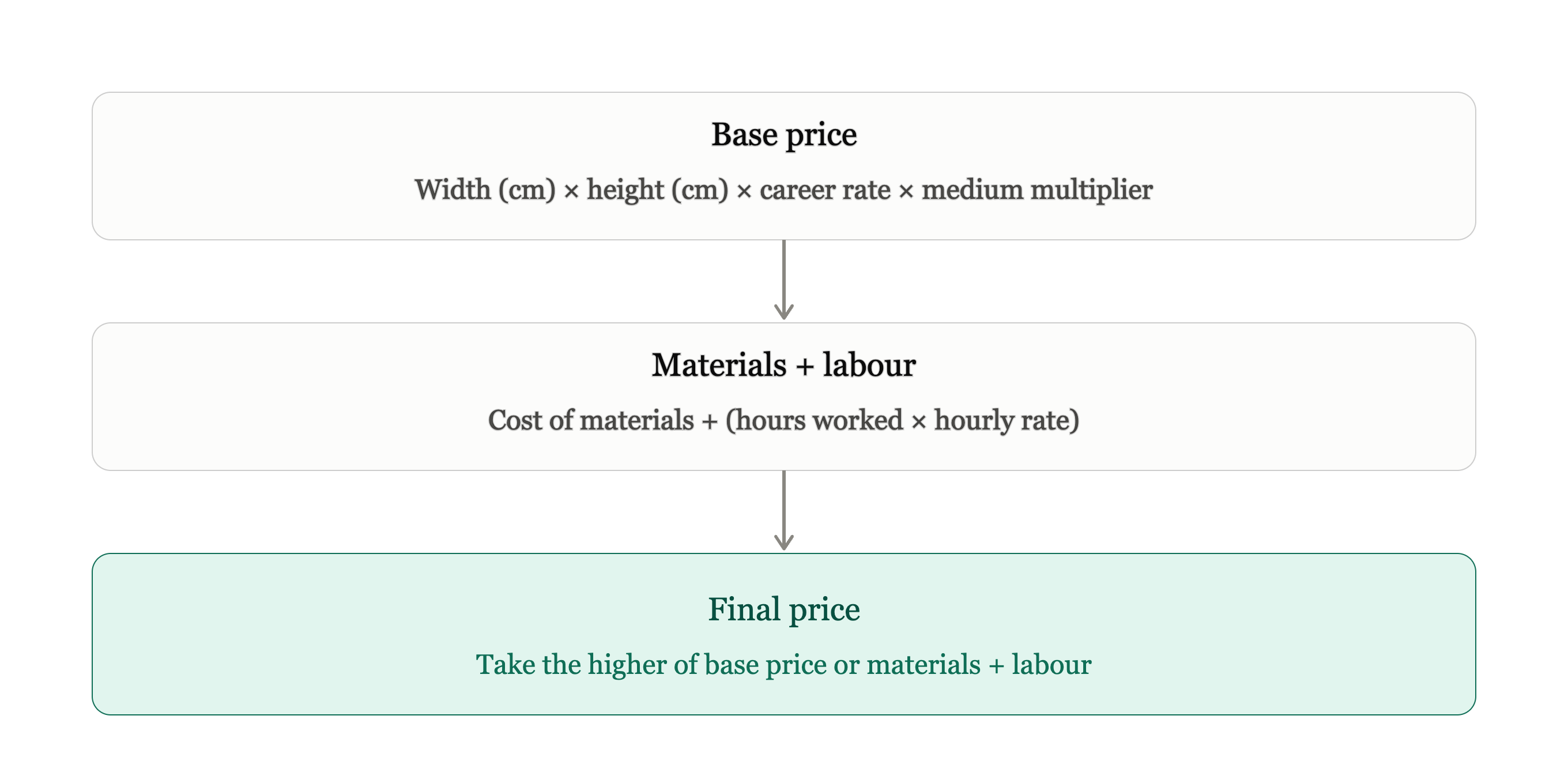
Width (cm) × Height (cm) × Career rate × Medium multiplier = Base price
Add: cost of materials + (hours worked × hourly rate)
Take the higher of this result or the formula result.
Career rates (UK, 2026):
Emerging: £0.15-£0.20/cm²
Developing: £0.28-£0.38/cm²
Established: £0.55-£0.80/cm²
Medium multipliers:
Oil on canvas: ×1.30
Acrylic on canvas: ×1.10
Watercolour/pastel: ×0.90
Remember: The formula gives you a floor. The five factors above tell you where between the floor and the ceiling your specific painting sits.
References
Social signals predict contemporary art prices better than visual features - Scientific Reports (Nature), January 2026. nature.com
Art Basel and UBS Global Art Market Report 2026 - Arts Economics / Dr. Clare McAndrew. artbasel.com
AI art is selling for millions: so why are collectors buying handmade again? - UC Strategies, February 2026. ucstrategies.com
How to price paintings: a step-by-step formula for artists - Milan Art Institute, August 2025. milanartinstitute.com
Artwork pricing model integrating the popularity and ability of artists - AStA Advances in Statistical Analysis, Springer, July 2024. springer.com
Made with love by artists, for artists.
Stay connected with us on Instagram for more artist stories and market updates.