Small paintings, big stories - Unusual art sales Ep. 2
Reading time: 6 minutes
We are back. If you caught Episode 1, you already know that some of the most interesting stories in the art world don’t begin in a gallery on Bond Street. They begin in charity shops in Surrey, attics in Cheshire, and car boot sales on rainy Saturday mornings.
Today we have three new stories - fresh from 2025 and 2026 - that prove nothing has changed. Paintings still go missing. They still turn up in the most unlikely places. And the people who find them are almost never the ones you would expect.
1. The painting that survived sixty years on a living room wall in New York
In 1966, a young art teacher named Helene Plotkin was browsing a charity shop in White Plains, a suburb north of New York City, looking for something to decorate her new home. She was pregnant with her first child. She had a budget of under a hundred dollars.
She found a painting.
It was a portrait of a seated woman in dark clothes, wearing an iridescent green headwrap. The colour theory stopped her immediately. “The way the pastels were integrated into the composition was both interesting and bold,” she would later say. “It was clearly the work of a significant hand with a deep understanding of light and form.” The signature in the upper right corner was illegible. She bought it anyway. She paid less than $100.
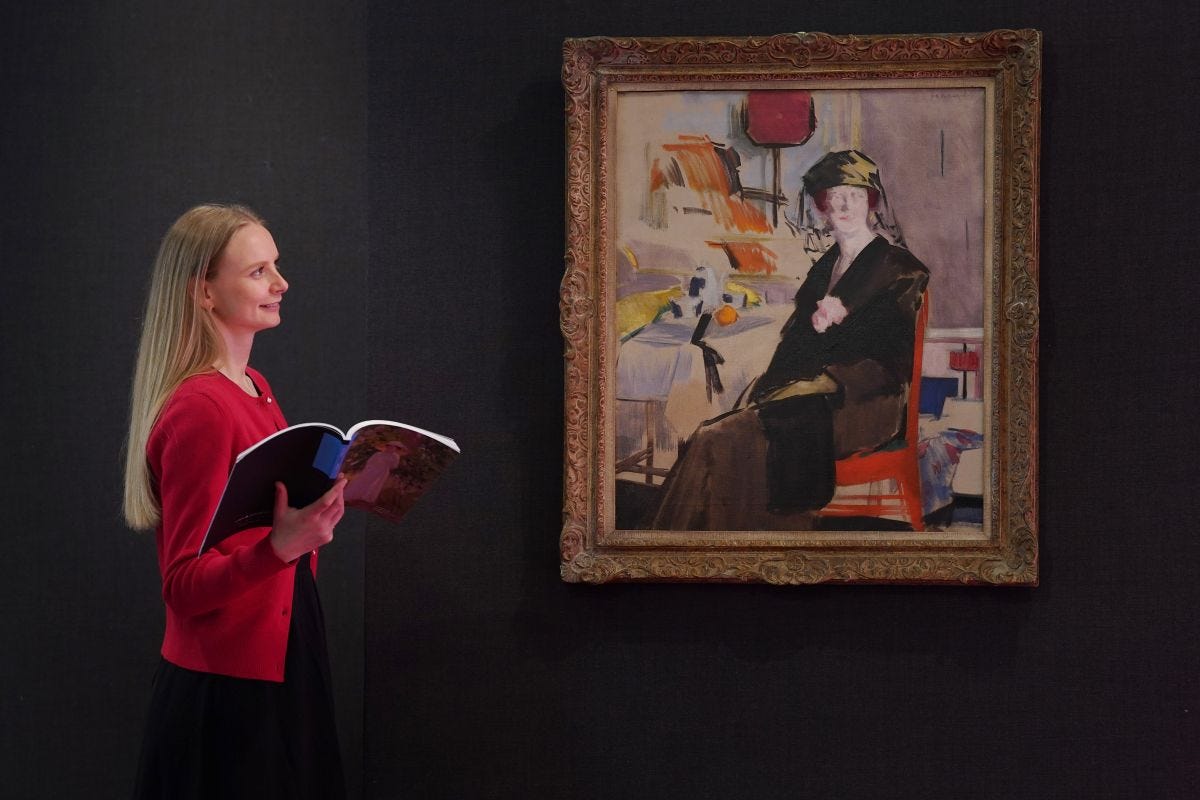
The painting hung on the family wall for the next six decades. Her sons played American football in front of it. “It was always there in the background,” her son Barry recalled. “It’s amazing it survived our childhood.”
It was Barry who, last year, decided to finally investigate. He turned to AI to help decipher the illegible signature, and the trail led him to Edinburgh auction house Lyon & Turnbull. Their specialists took one look and confirmed what Helene’s eye had always suspected.
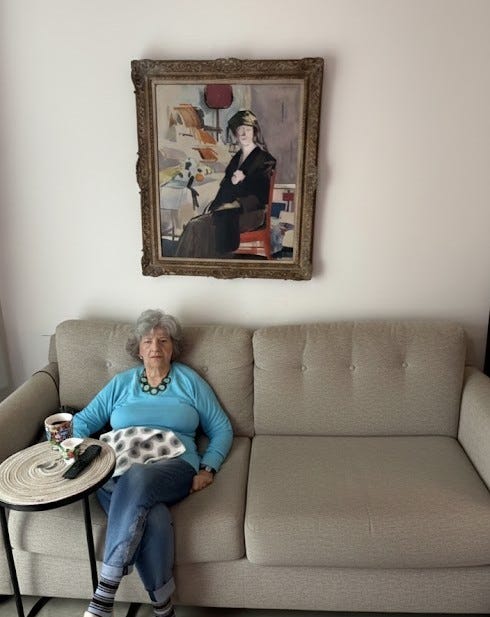
The painting was Interior: The Lady in Black, by FCB Cadell - one of the four Scottish Colourists, the radical group of early twentieth-century painters who brought the fresh energy of French Fauvist colour to Scotland. The sitter was identified as May Easter, one of Cadell’s favourite models. The work dates from the 1920s, the peak of his career.
What makes this story particularly striking is what the auction house discovered next: Interior: The Lady in Black had previously been sold by Christie’s London in 1966 - just months before Helene found it in White Plains - for the sum of £21. Somehow, between London and New York, the work had vanished into the ether. It had been hanging on a suburban family’s wall for sixty years.
At Lyon & Turnbull’s Scottish Paintings & Sculpture auction in June 2026, the painting sold for £189,200, including buyer’s premium. That is roughly 9,000 times what Christie’s achieved for it six decades earlier.
Helene Plotkin is now 88 and lives in Florida. Her eye was right all along.
2. The lost landscape that came home via a phone call
A charity shop in the East Midlands received a house clearance. Among the donated items was a small, dark, unremarkable landscape painting. The shop manager almost missed it.
Almost.
On the back of the canvas was a worn label, partially legible: “Summer, Joan, Exhibited, The Scottish Gallery.”
The manager phoned The Scottish Gallery in Edinburgh, not knowing quite what to expect. What followed was a piece of detective work that could have come from a novel. Gallery director Tommy Zyw searched the archive by hand - the physical day books, handwritten entries going back decades. He found what he was looking for: a record from May 1961, recording the sale of a painting titled Summer Fields by Joan Eardley.
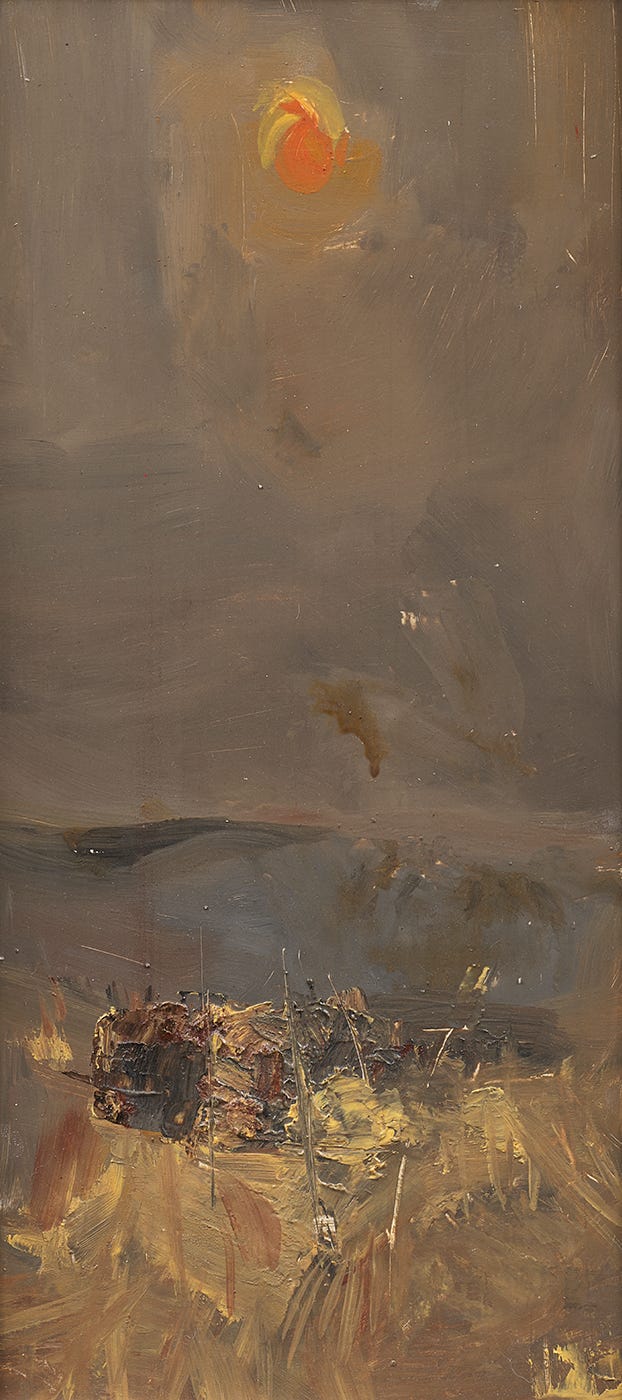
The painting was brought to Edinburgh for inspection. “From the moment it was unwrapped,” Zyw said, “its authenticity was clear. The surface, the handling and the authority of the mark all pointed unmistakably to Eardley.”
Joan Eardley is one of the most important Scottish painters of the twentieth century. She died of breast cancer in 1963, aged just 42, having spent her final years painting the landscape around the fishing village of Catterline in Aberdeenshire with an intensity that has never been fully equalled. Summer Fields, painted in Catterline, shows the corner of a farmer’s field in the golden light of late September, the foreground alive with textured grasses and seed heads. Quiet, powerful, irreplaceable.
After conservation work to stabilise the surface, the painting was unveiled at the British Art Fair in September 2025. It was subsequently acquired by a distinguished private collector of Scottish art. The charity received £29,000 from the sale - money that will fund medical research in the UK.
A worn label. A phone call. A 60-year-old handwritten entry in a gallery archive. That is what it took to bring this painting home.
3. When the unknowns outperformed the giants
Not every unusual art story involves a single painting hiding in a charity shop. Sometimes the surprise is in the market itself.
In 2025, something shifted in the auction rooms. Away from the usual spectacle of nine-figure Picassos and Warhols, a different kind of story was unfolding - one involving artists many collectors had barely heard of.
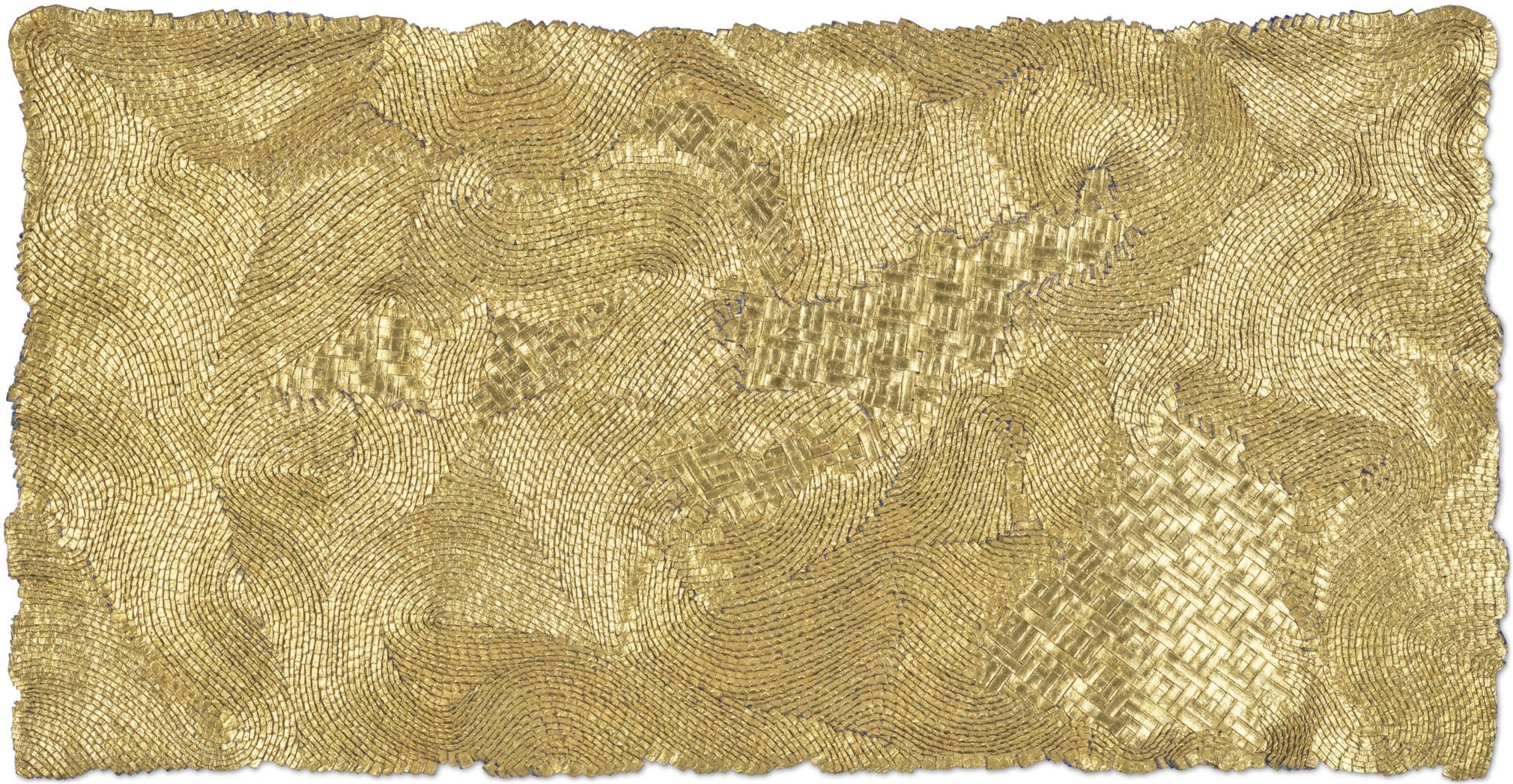
Olga de Amaral, a 92-year-old Colombian master of textile art, had been working in relative obscurity in international auction markets for decades. Then her retrospective opened at the Fondation Cartier in Paris, and everything changed. In November 2025, her textile work Pueblo H was offered at Christie’s New York with an estimate of $400,000 to $600,000. It sold for $3.125 million - more than five times the top estimate.
Lynne Drexler, an abstract painter who had spent most of her career in the shadow of the male protagonists of the New York School, saw her market accelerate rapidly throughout 2025. Her canvases, built from dense chromatic layers and rhythmic structure, had been consistently undervalued. In 2025, collectors corrected that.
And then there was the Rembrandt preparatory print, discovered by Edward Barlow in his late father’s studio. Barlow had modest expectations going into auction at Cheffins. The print sold for £22,100.
These are not stories about forgotten masterpieces being misidentified. They are stories about art whose value was always there, waiting for the right moment, the right eye, or the right exhibition to make it visible.
As the Artprice analysis of the year concluded: this movement “signals a critical re-reading of entire chapters of art history and a renewed interest from collectors in languages previously considered niche.”
What these three stories share
A living room in suburban New York. A charity shop in the East Midlands. An auction room in November in Manhattan.
Three completely different contexts. Three completely different kinds of discovery. But the same underlying logic connects all of them: value was always present. What was missing was the knowledge to see it.
Helene Plotkin had the eye. She knew the painting was extraordinary the moment she picked it up. What she lacked was the name of the artist, the provenance, the market context that would allow others to confirm what she already understood intuitively.
The Eardley painting sat in someone’s home for decades. The knowledge of what it was existed - in an archive, in a handwritten entry from 1961 - but it was not connected to the object.
And for artists like Olga de Amaral and Lynne Drexler, the work existed in full public view. What changed was not the art. What changed was the frame around it.
This is why understanding the value of your own work matters. Not because every painting in a charity shop is a lost Cadell. But because value, when it is not named and documented, has a way of disappearing - into house clearances, into illegible signatures, into decades of being passed over.
At Priceyourpainting, we believe every artist deserves to know what their work is worth - before it ends up on someone else’s wall.
Until next time...thank you for taking the time to read this article.
Made with love by artists, for artists 🫶🏼
References
FCB Cadell painting bought in US charity shop could fetch £200,000 at auction - Scottish Field, May 2026. scottishfield.co.uk
Francis Cadell painting bought for $100 in thrift store fetches more than $250,000 at auction - Boing Boing, June 2026. boingboing.net
Lost Joan Eardley painting discovered in charity shop in England returns home - The Scotsman, April 2026. scotsman.com
Artists auctions: 5 little-known talents shaking the market - Econique Art / Artprice analysis, December 2025. econique.art
Here Are 2025’s Most Unexpected Art-Historical Rediscoveries - Artnet News, January 2026. news.artnet.com