Why artist reputation drives painting prices (and how to build yours)
Reading time: 7 minutes
In 2005, a group of New York art dealers bought a damaged panel painting at a small auction in New Orleans. The work was heavily overpainted, structurally compromised, and attributed not to a master but to someone in a master’s circle. They paid around $1,200.
After restoration and reattribution to Leonardo da Vinci, the same painting - physically unchanged, still damaged, still disputed by scholars - sold at Christie’s New York in 2017 for $450.3 million.
Nothing about the object changed. Everything about the name attached to it did.
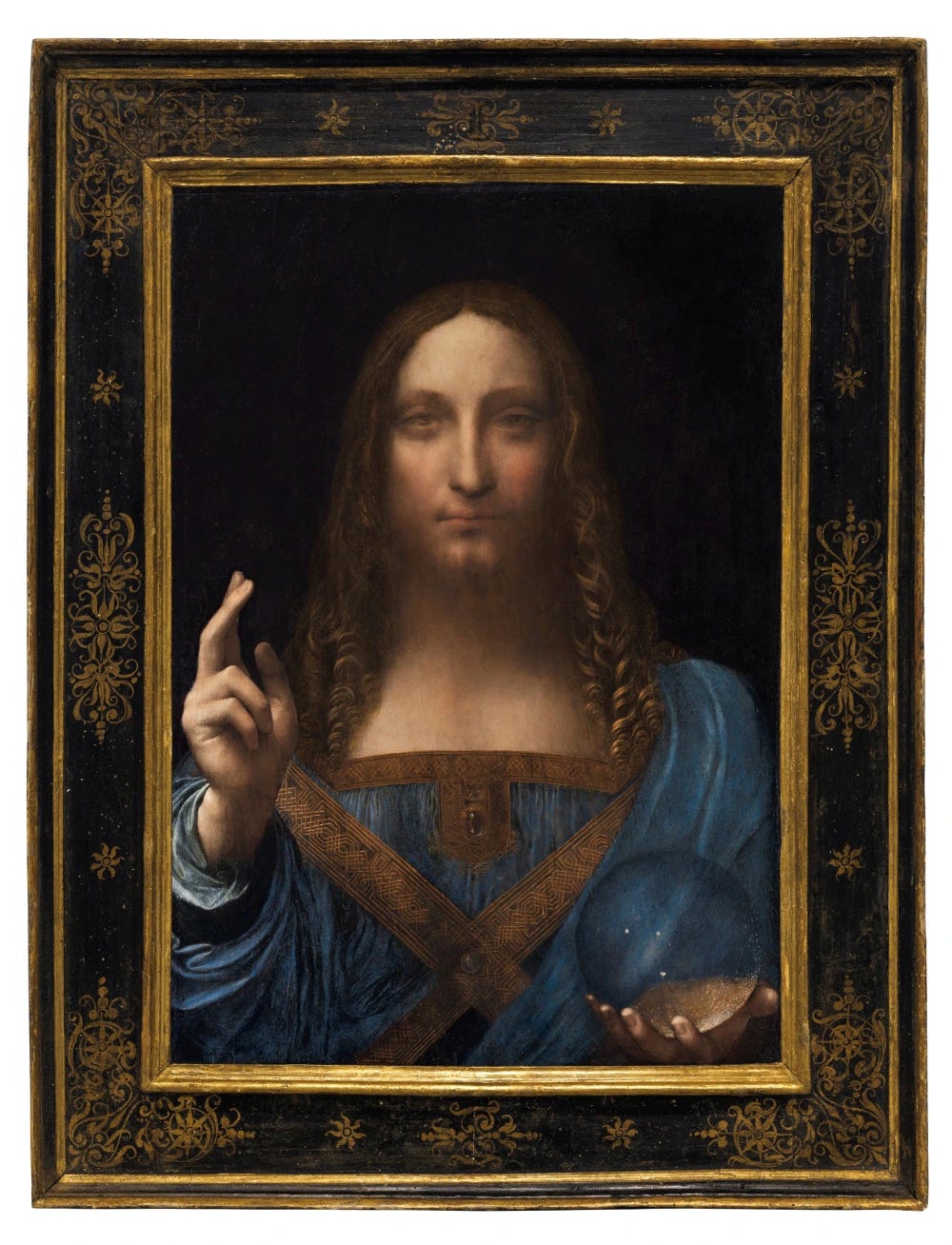
This is the most extreme example in art history of what researchers call the reputation effect - and understanding it is one of the most practically useful things an emerging artist can do for their career.
What the research actually says
A 2026 study published in Scientific Reports (Nature) examined art auction data for contemporary artists across global markets. Its finding was unambiguous: social signals - meaning the markers of an artist’s reputation and standing - predict artwork prices better than visual features. Not slightly better. Significantly better.
The study found this pattern was especially pronounced in emerging markets, where collectors struggle to assess quality independently. In those contexts, the research concluded, there is a stronger preference for “buying an artist” than “buying an artwork.”
This is not an isolated finding. A separate study from the AStA Advances in Statistical Analysis journal (Springer, 2024) found that among the key factors driving artwork prices, artist attributes consistently outweighed artwork attributes. The specific reputation signals that mattered most were: gallery representation, number of solo exhibitions, media awareness, awards, and exhibition at institutional venues.
Research published in Science illustrated the mechanism with a stark example: The Man with the Golden Helmet, an 18th-century painting attributed to Rembrandt, was Berlin’s most famous artwork for decades. When evidence emerged in the 1980s that it was not by Rembrandt, it lost much of its artistic and economic value overnight. The painting itself had not changed. The attribution had.
The conclusion across all this research is consistent: in the art market, reputation is not a soft, subjective quality. It is a measurable, quantifiable driver of price - and it operates independently of the visual qualities of the work itself.
Why this matters specifically for emerging artists
For artists at the beginning of their careers, this creates both a challenge and an opportunity.
The challenge is that reputation takes time to build. There is no shortcut. An artist who has shown at three open exhibitions and sold work to two collectors is not the same market proposition as an artist who has had a solo show, been reviewed in a regional publication, and has work in a public collection. The price difference between those two profiles can be substantial - research on the pricing model suggests the number of solo exhibitions alone is a statistically significant price predictor.
The opportunity is that reputation is not only built through gallery representation or prize nominations. The 2026 Scientific Reports study found that social signals in emerging markets increasingly include digital presence, collector networks, and the kind of visibility that was previously only available through institutional channels. An artist with a genuinely engaged audience - online or in person - is building a reputation signal, whether or not they have gallery representation.
The practical implication: every public appearance of your work is a reputation event. Every exhibition, every review, every sale to a named collector, every mention in a publication - these are not just nice things to have. They are the building blocks of the price your work will command in three, five, and ten years.
The five reputation signals that drive price
Based on the research and on how the market actually operates in 2026, these are the signals that matter most, roughly in order of impact:
Gallery representation. Still the most powerful single signal in the primary market. A gallery takes your work to collectors who trust its taste, provides institutional context, and handles the pricing conversation on your behalf. The effect is measurable: gallery-represented artists typically command higher prices at auction than unrepresented artists at equivalent career stages. If gallery representation is not yet accessible, artist-run spaces and co-operative exhibitions provide a credible intermediate step.
Exhibition history. The number of solo exhibitions is a statistically significant price predictor, according to the Springer research. Group shows matter less, but they matter. Institutional shows - even small regional institutions - carry more weight than commercial gallery shows in some collecting contexts. Document every exhibition formally: dates, venue, works shown, any catalogue or press. This history becomes part of your provenance.
Critical and editorial coverage. Media awareness is a measurable factor in the pricing models. A review in a regional newspaper, a feature in an art magazine, a mention in an online publication with genuine readership - each is a signal. Actively building relationships with writers, curators, and critics who might write about your work is not self-promotion. It is market positioning.
Provenance - who has bought your work. The identity of early collectors matters. A work that has passed through a recognised collection carries a premium over an identical work with an undocumented history. This means the decision about who you sell to early in your career has long-term pricing implications. A sale to an institution, a known collector, or a named collection creates a provenance trail that compounds over time.
Consistency of output and price. The research on auction dynamics shows that artists with established price records attract higher bids. A consistent body of work, consistently priced, builds the kind of market signal that collectors and dealers rely on. Erratic pricing - discounting for some buyers, inflating for others, or reducing prices when work does not sell quickly - sends negative signals to the market regardless of the quality of the work itself.
Understanding where your work sits in the current market is the first step to pricing with confidence. Our AI valuation compares your painting against real recent sales by artists at a similar career stage.
The compounding effect
What makes reputation particularly powerful as a price driver is that it compounds. An artist who builds a credible exhibition record attracts better gallery interest. Better gallery interest leads to collector introductions. Collector purchases create provenance. Provenance enables higher future prices. Higher prices attract critical attention. Critical attention builds the kind of institutional interest that leads to museum acquisitions or prize nominations.
Each step makes the next step easier. And each step raises the floor price of every work in the artist’s body of work - including work already sold.
This is why the research consistently shows that time in the market, combined with deliberate reputation building, is a stronger predictor of price appreciation than any single breakthrough moment. The artists whose prices grow most reliably are not necessarily the most visually distinctive - they are the ones who have built the most credible, well-documented, well-connected careers.
What to do now, practically
None of this requires a major gallery or a prize nomination to begin. The actions available to any emerging artist today include:
Document everything from the first sale. Keep a record of every exhibition, every buyer’s name (with permission), every review or mention, every institution that has shown or acquired your work. This documentation is the foundation of your provenance.
Price consistently. Use a formula - the square centimetre method is the standard starting point - and apply it across your whole body of work. Never discount and never raise prices in a way that creates inconsistency across similarly scaled works. Consistency is itself a reputation signal.
Show publicly as often as possible. Open exhibitions, artist-run spaces, online platforms with genuine curatorial credibility, pop-up shows with other artists whose reputation you respect - all of these create the exhibition history that the pricing models reward.
Seek reviews, even small ones. A mention in a local art publication is still a mention. A write-up on an art blog with genuine readership is still coverage. Every piece of editorial about your work is a reputation signal.
Build your collector relationships carefully. The first five to ten people who own your work will either help build your provenance or not. Treat these early relationships as long-term - stay in touch, let collectors know about exhibitions, give them the opportunity to see new work first.
The Salvator Mundi sold for $450 million because of a name. That is an extreme case of a mechanism that operates at every level of the market. The painting you make today is part of a career that is building, or not building, the reputation signals that will determine what your work is worth in ten years.
The work matters. But so does the story around it.
Priceyourpainting uses current market data to give you a price range that reflects your specific painting and career stage - not a formula estimate, but a market-backed valuation.
References
Social signals predict contemporary art prices better than visual features, particularly in emerging markets - Scientific Reports (Nature), January 2026. nature.com
Artwork pricing model integrating the popularity and ability of artists - AStA Advances in Statistical Analysis, Springer, July 2024. springer.com
Quantifying reputation and success in art - Science journal, Barabasi et al. science.org
Reputation, status networks, and the art market - Arts journal, MDPI, 2019. mdpi.com
The $450 million Da Vinci: Salvator Mundi and the price of belief - Curatedbydibyanshu / Substack, July 2025. substack.com
Da Vinci’s Salvator Mundi: the journey to a record price - Ars Mundi. arsmundi.de
Made with love by artists, for artists.
Stay connected with us on Instagram for more artist stories and market updates.