How artists are responding to war - the market for conflict art
Reading time: 6 minutes
In March 2026, as stock markets fell and geopolitical uncertainty reached one of its highest peaks in years, global collectors flew to London and spent more than $550 million on art in a single week - up over 50% from the previous year.
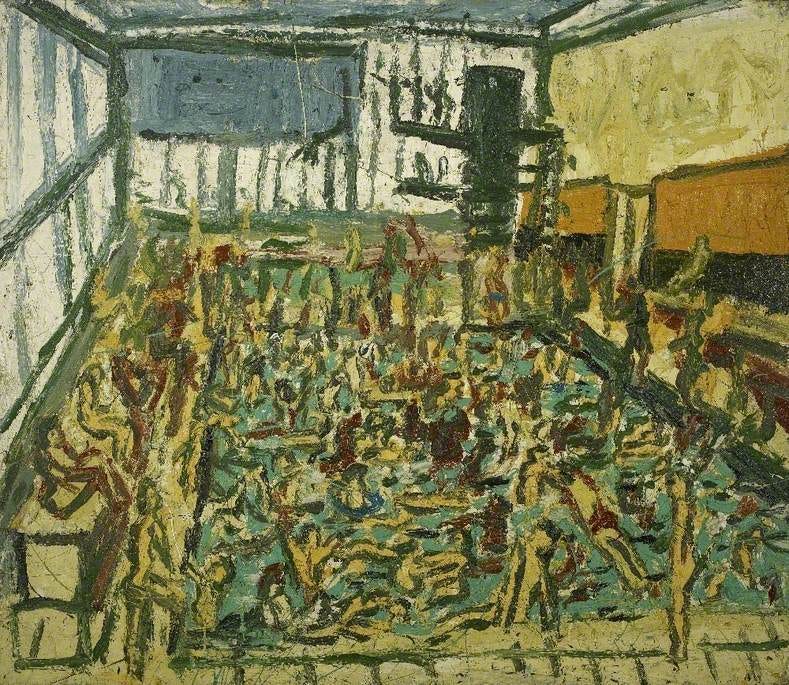
A self-portrait by Francis Bacon sold for $21.5 million, doubling its low estimate. A painting by Leon Kossoff sold for $7 million after a bidding war between ten bidders. A Henry Moore sculpture sold for $35.2 million, a record for the artist, after six bidders competed for it.
None of these works depicted war. But they were bought in the shadow of one - and the pattern is not coincidental.
What war does to the art market
The relationship between armed conflict and art market behaviour is not straightforward. War does not simply depress the market or inflate it. It restructures it - shifting what collectors buy, why they buy it, and where they choose to place their money.
The first response is almost always flight to quality. When conflict escalates, collectors move away from speculative positions in emerging or unproven artists and toward established names with proven cultural significance. The March 2026 London sales confirmed this precisely: Bacon, Kossoff, Moore - all canonical, all British, all artists whose market value is not in question. Collectors were not taking risks. They were consolidating into certainty.
Alongside this flight to quality, a second and apparently contradictory pattern emerges: art as an alternative asset. The Economic Policy Uncertainty Index, which incorporates geopolitical risk factors, correlates 0.68 with auction market volatility - meaning that as geopolitical uncertainty rises, art market behaviour becomes more erratic in both directions. Some collectors withdraw entirely. Others accelerate their buying, treating art as a store of value that is uncorrelated with financial markets and physically transferable.
The result is a market that becomes simultaneously more conservative at the top - favouring established names, large auction guarantees, single-owner collections with clear provenance - and more active in its lower tiers. In 2025, artworks under $50,000 made up 61% of all lots sold, significantly higher than the pre-pandemic average of 48%. The buyers who cannot access the Bacon and Moore price points are still buying, and they are buying in volume.
This is the market that emerging artists are actually selling into in 2026. Not the $21 million Bacon market. The sub-$50,000 market that is growing, active, and composed of collectors who are taking art seriously as an acquisition regardless of what is happening geopolitically.
What conflict art specifically sells for
There is a category of art in which the subject matter of war is not incidental but central - works that depict, document, or respond directly to armed conflict. This category has a complex and sometimes counterintuitive commercial history.
Picasso’s Guernica (1937) is the canonical example. Painted in response to the aerial bombing of the Basque town of Guernica during the Spanish Civil War, it is now estimated to be worth between $1.2 and $1.8 billion - though it is owned by the Spanish state, cannot be sold, and does not travel due to conservation risk. Its value is entirely theoretical. What it demonstrates is that work made in direct response to a specific act of wartime violence can become the most commercially significant painting in an artist’s entire body of work - more than two decades of work across every other style and subject.
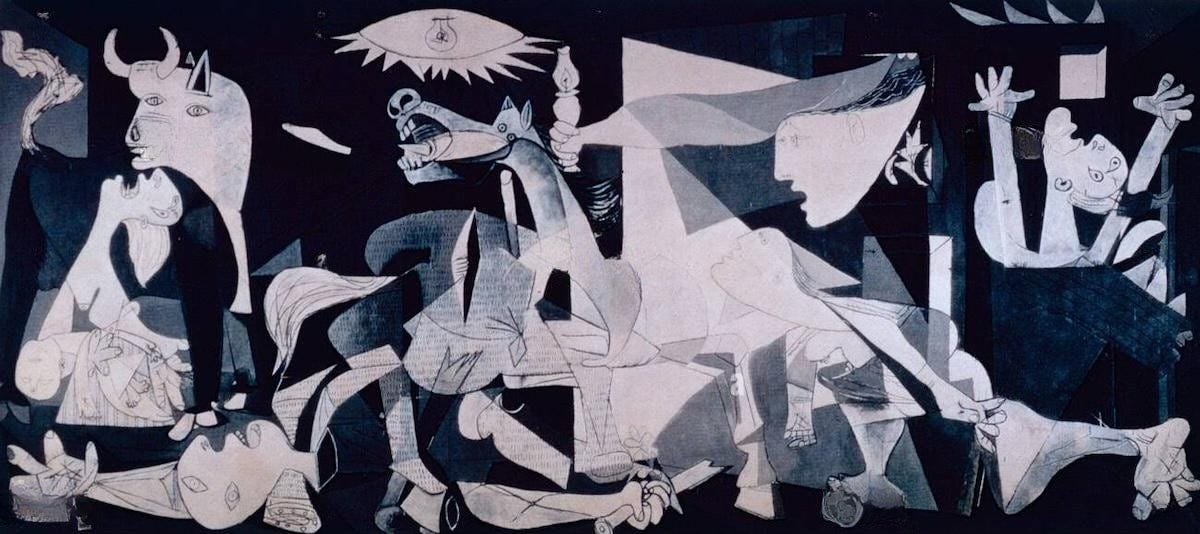
That is not a typical outcome. But the underlying principle - that conflict art can carry a premium when the event it documents becomes historically significant - is well-established. Post-conflict market recovery patterns show systematic institutional acquisition acceleration: museum acquisition budgets increased 234% during post-conflict recovery periods in historical precedent cases, as institutions rushed to build collections that would serve as cultural records of what had happened.
The contemporary equivalent is playing out in real time. Works by Ukrainian artists have seen increased institutional interest since 2022 - not because the art market has sentimentalised the conflict, but because curators and collectors understand that this work will function as primary historical evidence of a specific moment in European history.
The collectors who are buying now
The question of who buys conflict art is more nuanced than it might appear. There is no single “conflict art collector.” There are several distinct buyer types, each with different motivations and price points.
Institutional buyers - museums, university collections, public art funds - tend to acquire work that documents specific conflicts with historical rigour. They are less interested in the emotional register of the work than in its evidential quality: who made it, when, where, and under what conditions. Provenance and documentation are primary considerations.
Private collectors motivated by social impact are a growing segment. The Art Basel and UBS Global Art Market Report 2026 confirmed that social impact has become a major factor in art acquisition, with collectors actively seeking artists who address conflict, displacement, and human rights. This is particularly pronounced among collectors aged 30-45, who now represent nearly one-third of all high-net-worth art spending globally.
The third buyer type is the one least often discussed: the collector who buys conflict art as part of a broader thematic collection without specifically curating around conflict as a subject. A collector interested in German postwar art who buys Anselm Kiefer. A collector interested in contemporary British painting who buys Leon Kossoff’s dense, worked surfaces that carry the weight of wartime London without depicting it directly. This is where the largest volume of conflict-adjacent art changes hands - not in dedicated conflict art sales but in the general market, where the historical context of the work is part of its biographical and provenance story rather than its primary selling point.
If your work engages with conflict, history, or memory - or if you are simply an artist trying to understand what the current market will pay for your paintings - our free AI valuation gives you a market-backed price range in under a minute.
How geopolitical uncertainty affects prices across the market
The 2025-2026 period has produced a specific set of market conditions that affect every artist selling work, regardless of subject matter.
Single-owner collections accounted for 38% of New York auction value in 2025, compared with just 7% between 2015 and 2020. Guarantees backed 78% of the value of major evening sales, up from 36% in 2016. These two trends reflect a market in which sellers are risk-averse and auction houses are competing aggressively for the best material - a dynamic that benefits established artists with clear records and makes the path to auction harder for emerging artists without one.
At the same time, the sub-$50,000 market has never been more active or more accessible. Online auctions, platform sales, and direct-to-collector channels have expanded the buying base significantly. The collectors who could not compete for a $7 million Kossoff in London are buying original work at prices between £500 and £5,000 from artists they find through Saatchi Art, Instagram, and platforms like Priceyourpainting.
The FIRSTonline analysis of war’s impact on the international art market, published in June 2026, identified a specific dynamic that is directly relevant to emerging artists: armed conflict generates greater visibility for artists addressing themes related to war, collective memory, and resistance. War not only impacts prices and transactions, it also changes the content and values that collectors seek and appreciate. A collector who becomes engaged with the subject of conflict - through news, through a museum exhibition, through a conversation - becomes a potential buyer for art that engages with that subject at any price point.
What this means for artists working with conflict themes
If your work addresses war, conflict, displacement, or historical trauma, the current market offers you specific opportunities and specific risks.
The opportunity is real. Institutional interest in this category is growing. The collector base for socially engaged art is expanding. Work that documents a specific conflict or historical moment has demonstrated the capacity to accrue cultural and commercial significance over time - sometimes dramatically, as the Nussbaum and Kiefer examples show.
The risk is equally real. Work that appears opportunistic - that adopts conflict imagery as a subject without genuine engagement - is read as such by collectors and curators. The buyers in this category are sophisticated. They distinguish between an artist who has spent years working through a historical or contemporary subject and an artist who has adopted that subject because it is visible in the news cycle. Provenance, consistency, and commitment of practice are the signals that distinguish one from the other.
The pricing implication is the same as for any other category: price based on your career stage, your medium, and the market for comparable work. Do not discount conflict-themed paintings on the assumption that buyers will not pay a professional price for difficult subject matter. The evidence from both historical precedent and the current market suggests the opposite: collectors who are genuinely engaged with this category are willing to pay, and they are willing to pay properly.
The number that anchors everything
Guernica is estimated at $1.2 to $1.8 billion and cannot be sold.
That figure is not useful as a comparable - it is useful as a principle. A painting made in direct response to a single act of political violence, using the most traditional means available (oil on canvas), by an artist who was already established but not yet at the peak of his commercial market, has become the most valuable work in his entire body of work and one of the most culturally significant objects in the world.
The conditions that produced Guernica were not unique to 1937. They are present now, in the work being made by artists in Ukraine, in Gaza, in Sudan, in the studios of London and Berlin where artists are processing what they are seeing from a distance. Some of that work will disappear. Some of it will survive and become the primary visual record of what this period was.
The market cannot tell you in advance which is which. Neither can the artist making the work. What the market can tell you is that it has consistently, over time, found ways to value the work that turns out to matter.
This is Part 2 of our series on how artists are responding to war.
Read Part 1: the artistic responses
Priceyourpainting gives you a market-backed valuation for your specific painting - whatever its subject, whatever its tradition.
References
Art and classic car auctions top $600 million despite Iran war - CNBC, March 2026. cnbc.com
May art auctions: three pieces could sell for $100 million each - CNBC, May 2026. cnbc.com
Art Basel and UBS Global Art Market Report 2026 - Arts Economics / Dr. Clare McAndrew. artbasel.com
Art Market Update Spring 2026 - Bank of America / ArtTactic. privatebank.bankofamerica.com
Wars and their impact on the international art market - FIRSTonline, June 2026. firstonline.info
How economic volatility from wars affects art auction prices in 2025 - MOMAA, February 2026. momaa.org
How much is Guernica worth? - Painting Meanings, January 2026. painting-meanings.com
Made with love by artists, for artists.
Stay connected with us on Instagram for more artist stories and market updates.