How much is my oil painting worth: a practical guide for artists
An oil painting is worth what a real buyer has paid for similar work, not what the materials cost you or what the painting means to you. That sounds harsh, but it is the most useful thing to know before you put a number on your work.
This guide is for artists who want to price their own oil paintings, and it also points you in the right direction if you are trying to value an old painting you have been given. It covers the factors that move value, three practical ways to get a range, and the mistakes that cost artists money.
Which question are you asking?
“How much is my oil painting worth?” is really two different questions.
If you painted it, you are setting a price. You are working out what a buyer will pay for a new work by you, given your track record. The methods below are built for this.
If you own a painting by someone else, especially an older one, you are asking a valuer to assess it. Value then depends on who painted it, whether it is authentic, its condition and its history, and that needs a specialist. Sotheby’s, for example, offers a free online estimate for paintings it believes it can sell. It describes these as auction estimates rather than formal appraisals, based on factors such as rarity, provenance, condition and market demand. If a painting is not a good fit, it says it will tell you and try to suggest another venue. Our guide to getting a painting appraised, free and paid explains your options.
The rest of this guide assumes the painting is yours.
What decides the value of an oil painting
No single number decides it. Valuers and buyers look at the same short list of factors, and you can assess each one for your own work.
Your reputation and track record. Who you are in the market matters more than almost anything else. Exhibitions, sales, reviews, a consistent body of work and a clear price history all count. We look at this in detail in why artist reputation drives painting prices.
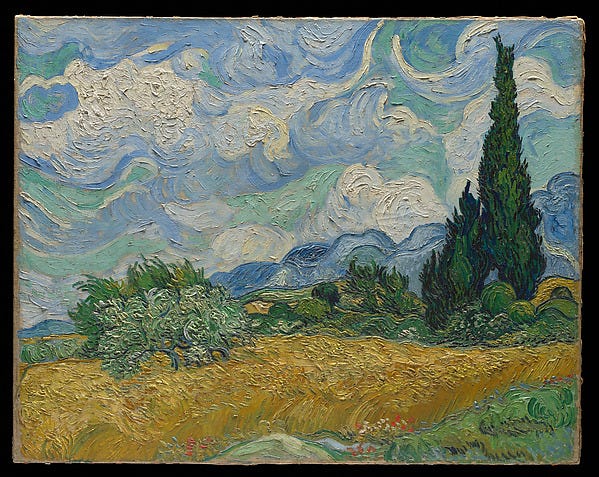
Size. Larger paintings generally cost more, though the relationship is not simple. Vincent van Gogh’s “Wheat Field with Cypresses” (1889) measures 73.2 x 93.4 cm, and size is only one part of what made it what it is. For your own work, size is the factor that is easiest to put a number on.
Condition. Cracking, flaking, tears, a loose canvas or a damaged frame all reduce what a buyer will pay. Conservators advise against pressing or touching a flaking surface and say to consult a conservator, and they recommend lining a canvas (bonding a second canvas to the back) only when it is needed for the painting’s long-term safety. Do not clean or repair a painting yourself before a valuation.
Provenance and documentation. A dated record of where the painting was made, shown, sold and stored makes it easier to trust. For a living artist that means photographs, dates, receipts, exhibition listings and any press.
Quality, subject and authenticity. A confident, finished work with a clear signature and a recognisable subject is easier to sell than one that looks tentative. For work by others, authenticity is the question that overrides all the rest.
Medium and support. Valuers record these precisely: oil on canvas, oil on board, oil on panel. You should too, on every label, price list and listing.
Method 1: price by size and time
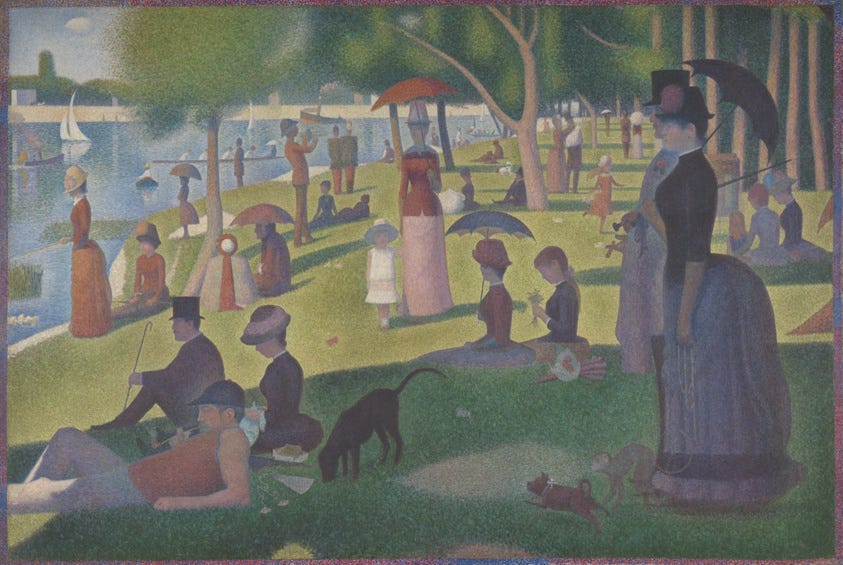
To see how widely sizes run, look at Georges Seurat’s “A Sunday on La Grande Jatte” (1884 to 1886), an oil on canvas that measures 207.5 x 308.1 cm, roughly three times the height and width of the Van Gogh above.
This is the simplest way to set a first price, and it gives you a floor. Artwork Archive describes three common formulas. The rates below are the article’s examples, not market data, so use your own.
Square inches x a rate. Multiply width by height, then by a rate that reflects your reputation. Artwork Archive’s example is an 18 x 24 inch painting (432 square inches) at $4 per square inch, rounded to $1,700, plus $200 in materials, for $1,900. The author notes that larger works call for a smaller rate per inch.
Hourly wage x hours + materials. Their example is $20 an hour for 15 hours, which is $300, plus $100 in materials, for $400. It suits artists just starting out.
Linear inches x a rate. Add height and width, then multiply. At $20 per linear inch, a 4 x 4 inch piece is $160 and a 32 x 32 inch piece is $1,280. It avoids the very large gaps between small and large works that square-inch pricing can produce.
The same article advises emerging artists to set lower rates than established ones and not to price above what your buyers will pay. If you sell through a gallery, add for commission: Artwork Archive describes a typical gallery commission of 50%.
Method 2: check what similar work has sold for
A formula tells you what you would like to charge. Sold prices tell you what buyers have paid.
Auction databases record sales of artists’ work. The Artnet Price Database, for example, covers about 18 million auction results back to 1985, but it only includes items estimated at $500 or more, and all search access is paid. At the time of writing its one-day pass is $32.50 and a 30-day plan is $42.50, so check current prices. Other databases, such as MutualArt and askART, exist too, and their access terms differ.
For most emerging artists, auction records do not exist yet, so the comparison is different:
Find artists at a similar stage, working in a similar size and medium, and look at what they ask.
Remember that an asking price is not a sale price. Look for work that has sold, such as pieces marked sold or with sold dates.
Compare like with like: size, medium, subject and career stage.
Note where the market is. The Art Basel and UBS Global Art Market Report 2026, which covers 2025, found that, at auction, sales of works under $50,000 fell 2% in both value and volume. That is the tier where most emerging artists sell, so clear, consistent prices matter.
Method 3: ask a specialist
A specialist can give you an informed opinion that a formula cannot. For an old or inherited painting, this is the right step. Free auction-house estimates are one route. The caveats are that they are preliminary estimates, they depend on the house seeing the painting as saleable, and they are not formal appraisals for insurance or probate. If you need a certified appraisal, you will need a paid professional appraiser.
Method 4: get a quick estimate from a tool
A tool can give you a starting range in minutes, before you spend time on research. Our free tool at Priceyourpainting does this for original paintings. You upload an image and enter the size, medium, year, materials cost, hours worked and your sales history, and you get an estimated price range in about 30 seconds.
It is a guide to the market, not a formal appraisal, and it does not authenticate anything. Use it as a second opinion on the number from Method 1, not a replacement for it.
How to read the three results together
You will probably end up with three numbers: a floor from a formula, a range from comparable work, and perhaps an opinion from a specialist. Do not average them. Use each for what it tells you.
The formula is your floor. If a comparable artist at your stage sells similar work for much less, check whether your size or medium really justifies the gap. If they sell for much more, ask what they have that you do not yet have, such as exhibitions, press or a longer sales record. A specialist’s estimate tells you how the wider market might see the painting, which is useful context, but it is not a promise that you will sell at that figure.
Then choose one price, write down the reasoning, and apply the same method to every painting you make. Buyers notice when two similar works carry unrelated prices, and a record of how you priced makes it easier to raise your prices later with a clear conscience.
Common mistakes when valuing your own oil painting
Pricing by cost alone. Materials and hours give you a floor, not a value.
Pricing by feeling. The painting may mean everything to you, and a buyer cannot see that.
Copying a famous artist’s price. Their price reflects decades of reputation, not your work.
Changing prices without a method. Artwork Archive stresses that consistent pricing builds credibility with buyers and collectors and keeps you in good standing with galleries.
Cleaning or restoring before a valuation. Leave condition work to a conservator.
Forgetting commission. If you sell through a platform or gallery, your listed price has to cover their share and still leave your margin. See where platforms stand in our guide to where to sell your paintings.
A quick checklist before you set a price
Record the title, year, medium, support and dimensions.
Photograph the front, back, signature and any damage in good light.
Write down your exhibition and sales history.
Work out your floor with a size, time formula or a tool.
Look at three to five comparable works and note their sold or asking prices.
Choose a price, write down why, and use the same method for every painting.
For more on how the factors fit together, read our five factors that determine a painting’s value, our practical guide to pricing oil paintings and our complete guide to valuing a painting.
References
Artwork Archive, “How to price consistently for art sales success” (three pricing formulas, gallery commission), published 24 July 2015, updated 12 April 2021: https://www.artworkarchive.com/blog/how-to-price-consistently-for-art-sales-success
Sotheby’s, “Sell paintings” (free auction estimates, factors assessed): https://sothebys.com/en/sell/paintings
Fine Art Restoration Company (Danielle Burke, 2018), “Common problems that affect oil paintings”: https://fineart-restoration.co.uk/guides-and-advice/common-problems-that-affect-oil-paintings/
Artnet, Price Database (coverage and pricing): https://www.artnet.com/price-database
The Art Basel and UBS Global Art Market Report 2026 (Arts Economics): https://www.artbasel.com/stories/the-art-basel-and-ubs-global-art-market-report-2026 ; summary: https://www.finestresullarte.info/en/market/global-art-market-returns-to-growth-in-2025-up-4-percent-and-59-6-billion
The Metropolitan Museum of Art, collection object 436535 (Van Gogh): https://www.metmuseum.org/art/collection/search/436535
Art Institute of Chicago, artwork 27992 (Seurat): https://www.artic.edu/artworks/27992
Made with love by artists, for artists 🫶🏼
info@priceyourpainting.com | www.priceyourpainting.com | Instagram