How to price your art as an emerging artist: a step-by-step method
Most emerging artists price by instinct, and instinct tends to go wrong in one of two directions. Either the number is so low that it signals the work is not valued, or so high that nothing sells and confidence takes a hit. A method fixes both, because it gives you a reason for every price and a way to change it later.
This guide covers the whole process for original paintings: a floor price from simple formulas, a reality check against the market, a quick estimate from a tool, what to do about commission, how to keep prices consistent, and when to raise them. If you only need the quick version for oil paintings, start with how much your oil painting is worth.
Start with where you are in your career
The same painting is worth different amounts depending on who made it. Reputation, exhibition history, sales record and press all feed the price, so be honest about your stage before you pick a number. We look at this in why artist reputation drives painting prices.
A simple way to think about it:
Just starting. Few or no sales, no exhibitions. Your price rests mostly on costs and on what comparable beginners ask.
Building a record. Some sales, a few group shows, a small following. You can price with more confidence, and you should track what sells.
Established locally or online. A repeat buyer base, a gallery relationship or a waiting list. Prices can rise on evidence, not hope.
Artwork Archive’s pricing guide gives the same advice in short form: emerging artists should generally set more affordable rates than established ones, and should “not outprice your buyers”.
Step 1: Work out your floor with a formula
A formula will not tell you what a painting is worth, but it stops you selling below what it cost you to make. Artwork Archive describes three common ones. The dollar figures in its examples are illustrations, not market data, so substitute your own rates.
Square inches x a rate. Multiply width by height, then by a rate that suits your stage. Artwork Archive’s example is an 18 x 24 inch painting at $4 per square inch, rounded to $1,700, plus materials. It suggests using a smaller rate per inch on larger works.
Hourly wage x hours + materials. Decide on an hourly rate you could defend, count the hours honestly, then add the cost of materials. It is often the easiest place to start.
Linear inches x a rate. Add height and width, then multiply. It avoids the very large jumps between small and large works that square-inch pricing can produce, and Artwork Archive cites the artist Melissa Dinwiddie as recommending it when you paint in many sizes.
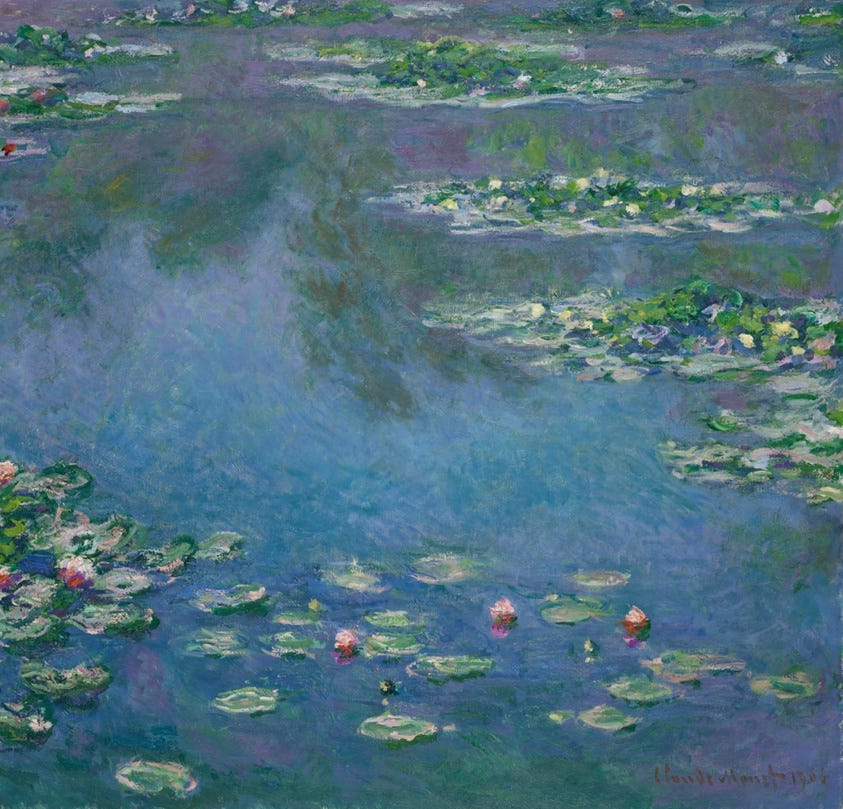
To see how much real works vary, Claude Monet’s “Water Lilies” (1906) measures 89.9 x 94.1 cm, a size you can plug into any of these formulas. Pick one method and use it for every painting. Our practical guide to pricing oil paintings goes through the same formulas with worked examples.
A worked example (illustration only)
These numbers are invented to show the arithmetic. They are not market prices.
Suppose you paint a 40 x 50 cm piece in 20 hours and spend £60 on materials. At an hourly rate of £15, the time formula gives:
20 hours x £15 = £300
plus £60 materials = £360
That £360 is your floor if you sell directly. Now suppose you also sell through a gallery that takes a 50% commission, which Artwork Archive describes as what galleries “usually take”. To receive £360 yourself, the painting has to be listed at £720. If you are not willing to list at £720, you either need a lower cost base or a different channel.
This is the single most useful result of doing the arithmetic: it shows you what a commission really does to your price.
Step 2: Check your number against the market
A formula tells you what you would like to charge. Sold prices tell you what buyers have paid. Check both.
For emerging artists, there are usually no auction records yet, so the best comparison is other artists at a similar stage:
Choose five to ten painters with similar work, size and medium.
Note their prices, and separate asking prices from sold prices where you can. Pieces marked sold, or with sold dates, are more useful than a number on a listing.
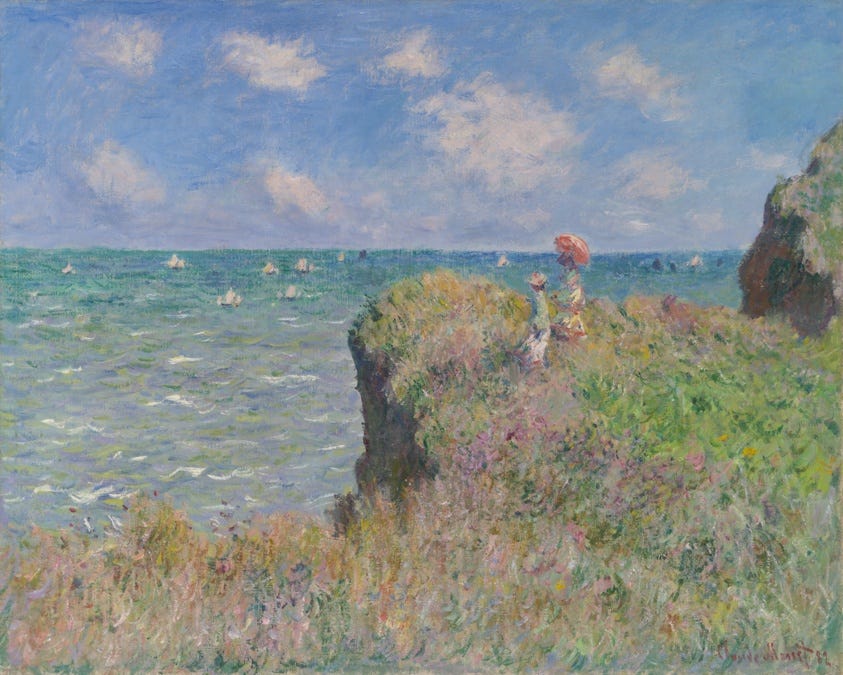
Compare like with like. Even one artist’s work varies a lot in size: Claude Monet’s “Cliff Walk at Pourville” (1882) measures 66.5 x 82.3 cm, smaller than his “Water Lilies” (1906), so the two would never be priced the same way.
If your formula number is far below the comparables, you may be undercharging. If it is far above, ask what they have that you do not yet have, such as exhibitions, press or a longer sales record. For established names, auction databases such as the Artnet Price Database record past sales, but access is paid and it only covers items estimated at $500 or more, so it is rarely useful at the start of a career.
Step 3: Get a second opinion with a tool
A formula and a handful of comparables take time. A tool can give you a third number in minutes, which you can then test against the first two. Our free tool at Priceyourpainting is built for exactly this step, for original paintings. You upload an image and enter the details you have already gathered: size, medium, year, materials cost, hours worked and your sales history. In about 30 seconds you get an estimated price range.
Here is how to use it well:
Enter the same numbers you used in Step 1. If your hours and materials are honest, the range will be easier to compare with your formula.
Read the range, not a single figure. A wide range means more uncertainty. Narrow it by being accurate about your sales and exhibition record.
Compare it with your floor. If the tool’s range sits well above your formula, you may be undercharging. If it sits below, check that your size, medium or record justify the gap.
Keep a dated copy with your price list, so you can show how your price developed.
It is a guide to the market, not a formal appraisal, and it does not replace the checks in Step 2. If you later want a more detailed document, Estimate+ is what you’re looking for.
Step 4: Understand the market you are selling into
Prices do not exist in a vacuum. The Art Basel and UBS Art Market Report 2026, written by Arts Economics, estimated global sales at $59.6 billion in 2025, up 4%. The UK reached $10.5 billion, up 2%, and the US reached $26.0 billion, up 5%. Online sales fell to $9.2 billion, their lowest level since 2019, and at auction both the value and the volume of sales under $50,000 fell 2%.
Two readings are fair. The market overall grew, but the lower end is cautious, and most emerging artists sell at the lower end. In that environment buyers respond to clarity: a price that makes sense, a consistent policy, and visible reasoning. We cannot say from this data what any one artist should charge, only that the climate rewards credibility over cleverness.
Step 5: Keep the price the same everywhere
Whatever you decide, the price for the same painting should match across every place it is sold: your website, a gallery, a marketplace and your Instagram. Artwork Archive says consistent pricing builds credibility with buyers and collectors, and The Curator’s Salon makes the same point about raised prices: they should match across every venue where the work is sold.
In practice this means:
Price with the highest commission in mind, so you can keep the same list price everywhere.
Do not undercut your gallery on your own website.
If you offer a discount, make it a rule you apply to everyone, not a private favour, and put it in writing.
If you sell through marketplaces, check each platform’s current commission before you set the list price. Our guide to where to sell your paintings compares them.
Step 6: Build a simple price list
Once you have a method, turn it into a price list. For a consistent body of work, many artists group paintings by size and medium and give each group one price. That has three benefits:
Buyers can compare your works easily.
You never have to renegotiate your reasoning on each piece.
When you raise prices, you change one table, not twenty labels.
Keep the list in a spreadsheet with title, year, medium, support, size, price and status. Update it whenever a painting sells. That sales record becomes evidence for your next increase.
Step 7: Decide when to raise your prices
There is no perfect moment. The Curator’s Salon puts it simply: raise prices when you feel that the current ones are not serving you. It also lists situations that tend to justify a rise. These include:
A new body of work.
A work entering a public collection, or a prominent private one.
More exposure through publications, festivals or events.
A commission or a collaboration.
A prize.
Prices that have stayed the same for a long time.
Add one more that comes from your own records: if paintings sell quickly and you cannot make them fast enough, your price is probably low. The article names no fixed percentage, and neither will we. A modest step, applied to new work and applied consistently, is easier for existing buyers to accept than a sudden jump. Never raise the price of a painting that is already listed or promised to someone.
Common mistakes
Pricing by cost alone. Costs give you a floor, not a value.
Pricing by emotion. The work may mean everything to you, and a buyer cannot see that.
Copying famous artists. Their prices reflect decades of reputation.
Discounting without a rule. It trains buyers to wait.
Forgetting commission. Your list price must cover it and still leave your margin.
Mixing originals and prints. Prints and editions follow different logic. Price and list them separately.
No record of why. Write down how you arrived at each price. You will need it when someone asks.
A one-page checklist
Be honest about your stage.
Choose one formula and apply it to every painting.
Compare with five to ten similar artists and note sold prices.
Run a free estimate with your Step 1 numbers and compare the range with your floor.
Calculate the list price needed to cover the highest commission you will pay.
Make prices match across all channels.
Keep a price list and a sales record.
Raise prices on evidence, applied to new work, and tell your buyers.
For the wider picture, read our five factors that determine a painting’s value and our complete guide to valuing a painting.
Where to go next
Pricing an oil painting specifically? Our practical guide to pricing oil paintings adds medium and support adjustments.
Need a signed document, not an estimate? See how to get a painting appraised, free and paid.
References
Artwork Archive, “How to price consistently for art sales success” (three formulas, 50% commission, consistency, emerging vs established rates), published 24 July 2015, updated 12 April 2021: https://www.artworkarchive.com/blog/how-to-price-consistently-for-art-sales-success
Gita Joshi, “Art pricing, when to raise your prices and how art prices go up”, The Curator’s Salon (summary of a podcast episode, 2019): https://thecuratorssalon.com/blog/art-pricing-when-to-raise-your-prices-amp-how-art-prices-go-up
The Art Basel and UBS Global Art Market Report 2026 (Arts Economics): https://www.artbasel.com/stories/the-art-basel-and-ubs-global-art-market-report-2026
Artnet, Price Database (coverage and access): https://www.artnet.com/price-database
Art Institute of Chicago, artworks 16568 and 14620: https://www.artic.edu/artworks/16568 and https://www.artic.edu/artworks/14620
Made with love by artists, for artists 🫶🏼
info@priceyourpainting.com | www.priceyourpainting.com | Instagram