In this article (8 sections)
For a painter in Canada, the biggest market is next door. A US buyer finds your work online, wants the painting, and then three questions arrive: do I charge Canadian tax, what paperwork leaves Canada, and will my buyer be hit with duty at the border? This guide answers them for original paintings shipped from Canada to the United States, using the Canadian and US government sources linked at the end.
Rules in this area changed several times in 2025 and 2026, so each section says where its information comes from and how old it is.
Do you charge GST/HST on a sale to the US?
Start with whether you charge GST/HST at all. If your sales stay under the $30,000 small supplier line, you do not charge it on any sale, in Canada or abroad. We cover that rule in our Canada pricing guide, and how to determine the right price for your artwork covers the pricing itself.
Once you are registered, the Canada Revenue Agency’s guidance on exports of tangible personal property says a supply of goods that are exported can generally be zero-rated, which means taxed at 0%. The conditions depend on how the goods leave Canada. The main one is a sale to a recipient who exports the goods, and there are other routes, including the supplier shipping the goods abroad. In every case the CRA expects you to keep evidence that lets the whole shipment be traced from Canada to its destination: the sales invoice that identifies the painting and the buyer, matched to the shipping instructions, and a transportation document such as a courier or postal receipt. Paper and electronic records are both accepted. The page we used was last updated in 2018, so confirm the current wording with the CRA or your accountant before you rely on it.
Do you need an export declaration?
For most exporters the question is the Canada Border Services Agency’s export reporting. According to its exporters’ guide, last modified on 21 October 2024, an export declaration is not required for non-restricted goods going to the United States, whatever their value. The $2,000 threshold people mention applies to other destinations. Goods that need a permit, certificate or licence still need it, so check the CBSA guide if your painting includes anything unusual, such as materials from protected species.
What the US charges on an original painting
Under the US Harmonized Tariff Schedule, heading 9701 covers paintings, drawings and pastels executed entirely by hand. According to the US International Trade Commission’s Chapter 97, the general duty rate for these subheadings is free.

The heading is written for exactly this kind of work: a painting made by an artist’s own hand. It excludes hand-decorated manufactured articles, so a painted mug or a painted tote bag is not a painting for customs purposes. Prints are a separate matter, and this guide does not cover them.
Duty-free status is the default, but the United States repeatedly changed its emergency tariffs in 2025 and 2026. Renwick Fine Art Services, a US art shipping company, reported in May 2026 that art in headings 9701 to 9705 paid no duty and was exempt from the 10% Section 122 surcharge as informational material, a surcharge set to expire on 24 July 2026. We could not find a later source we trust. Before each shipment, ask your carrier or the buyer’s customs broker whether anything has changed for HTS 9701.
Frames change the size of the parcel
A painting that ships framed takes up much more room than its canvas. The Metropolitan Museum of Art lists Winslow Homer’s The Gulf Stream at 28 1/8 by 49 1/8 inches, and framed at 42 5/16 by 62 11/16 by 5 7/8 inches.
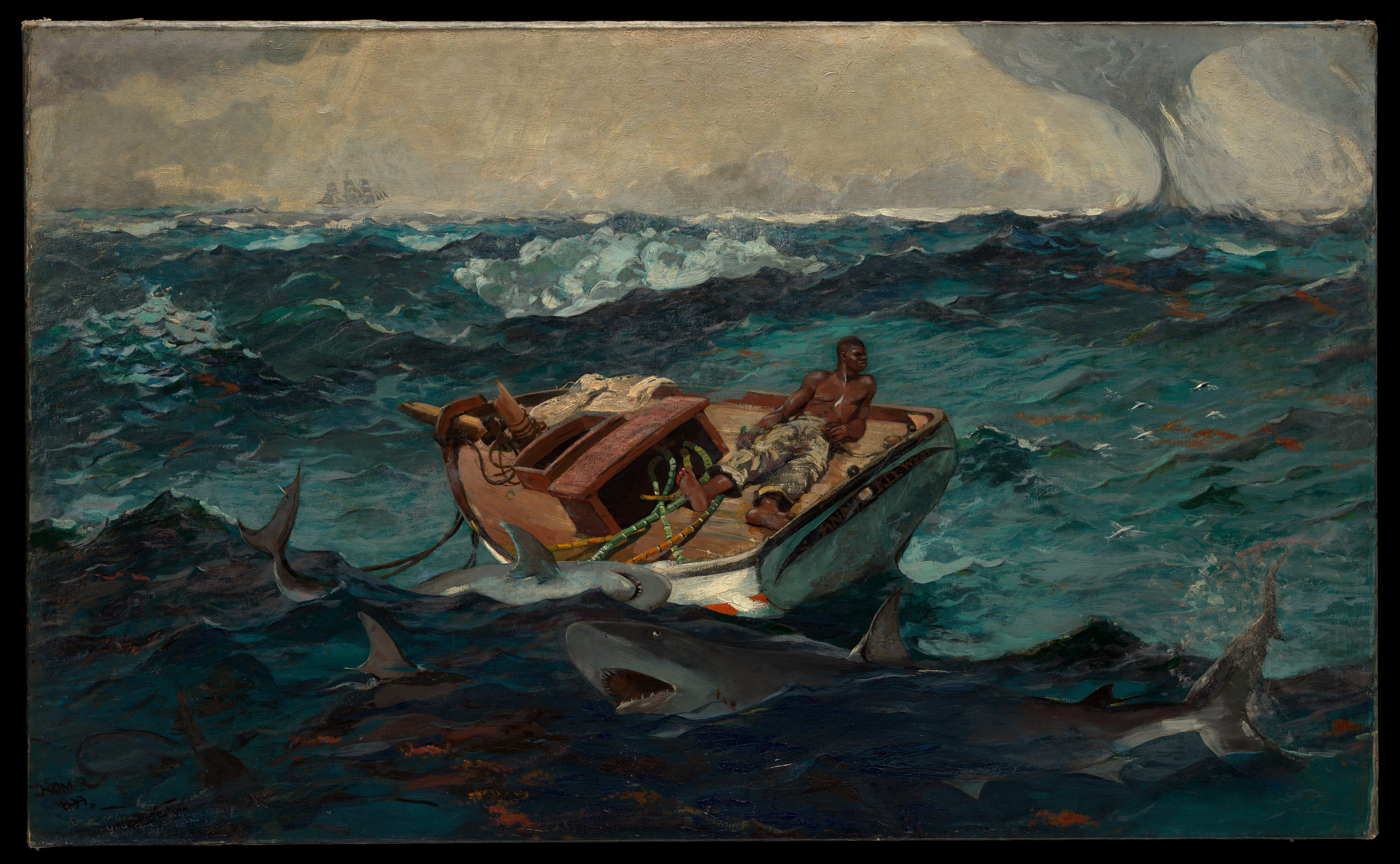
The Harmonized Tariff Schedule’s Chapter 97 notes say the frame of a painting is classified with the painting when it is of a normal kind and value, so an ordinary frame does not add its own duty line. Price the packing and the larger box into your shipping quote, not into the painting.
What changed for Canada Post parcels
On 29 August 2025 the United States suspended its US$800 duty-free threshold for all countries, including Canada. Canada Post’s page on the change, with a disclaimer dated 11 November 2025, says postal shipments valued under US$800 must have duties prepaid before they cross the border, and that every parcel to the United States needs a 13-character Declaration ID, which Canada Post recommends getting through Zonos. Without it you cannot create the label. For goods over US$800 the duty change does not apply, duties are collected on delivery, and the Declaration ID is still required. Country of origin is mandatory for every item.
The page does not mention artworks, so we cannot say how it applies to a painting, and it dates from November 2025. Treat the Declaration ID as a step every US label needs, and put the painting’s value and Canada as its country of origin on the customs form.
Where the money goes
Selling through a platform changes who pays for shipping. Saatchi Art charges a 40% commission on originals, and its page says the collector pays shipping. Direct sales and other platforms vary, which our guide to where to sell your paintings in 2026 compares. Whatever the route, fix the painting’s price first and add shipping separately, so your price does not move with the postage. If you are unsure of the price itself, start with how much is my painting worth: 5 factors.
Check your price before you ship
Our free estimator gives you an estimated price range for an original painting in about 30 seconds, using the size, medium, year of creation, cost of materials, hours worked and the last similar work you sold. More than 10,000 artists have used it. It is a guide to the market, not a formal appraisal, and it is built for original paintings only.
References
Canada Revenue Agency, “Exports - Tangible Personal Property” (GST/HST Memorandum 4.5.2), page dated 2018-05-29: https://www.canada.ca/en/revenue-agency/services/forms-publications/publications/4-5-2/exports-tangible-personal-property.html
Canada Border Services Agency, “Exporters’ guide to reporting”, modified 2024-10-21: https://www.cbsa-asfc.gc.ca/services/export/guide-eng.html
US International Trade Commission, Harmonized Tariff Schedule, Chapter 97: https://learning.usitc.gov/hts-docs/documents/Chapter%2097.pdf
Renwick Fine Art Services, “U.S. Art Tariffs In 2026: Practical Advice For Importers & Shippers”, 9 May 2026: https://renwickfas.com/articles/us-art-tariffs-practical-advice-2026/
Canada Post, “Shipping to the U.S. – duties update” and its FAQ (disclaimer dated 11 November 2025): https://www.canadapost-postescanada.ca/cpc/en/support/campaign/shipping-to-us-duty-updates.page
Saatchi Art, “Why sell on Saatchi Art”: https://saatchiart.com/whysell
The Metropolitan Museum of Art, collection records 09.95 (Church) and 06.1234 (Homer): https://www.metmuseum.org/art/collection/search/10481 and https://www.metmuseum.org/art/collection/search/11122
 Comment on Substack