In this article (8 sections)
The US accounts for 44% of global art sales by value, according to the Art Basel and UBS Art Market Report 2026. For a painter in the UK or Italy, it is the biggest market you can sell into without a gallery, and also the one where the shipping rules have changed most. Since April 2025, the US has changed its tariffs several times and ended the exemption for low-value parcels. This guide sets out what applies on 1 November 2026, with the source for each rule.
It covers original paintings only. It is not customs or tax advice, so confirm the details with a customs broker or your accountant before your first shipment. For the market itself, see our overview of art market trends in the UK, US and Europe, and for other places to sell, where to sell your paintings in 2026.
What US customs charge on a painting in 2026
There are three layers, and the answer for an original painting from the UK or Italy is currently zero on each, but only because of specific exemptions.
The base duty is free. Original paintings sit under heading 9701 of the US tariff schedule, and the general duty rate is Free. Renwick Fine Art Services, a fine art shipper, confirms in its May 2026 update that paintings stay duty-free under Chapter 97 when they are correctly classified.
The extra tariffs have been replaced twice. The tariffs imposed in April 2025 under the emergency-powers law (IEEPA) were struck down by the US Supreme Court in February 2026, according to Renwick. A temporary 10% global tariff (Section 122) then ran from 24 February and lapsed in late July. From 24 July 2026, a new set of tariffs under Section 301 applies to goods from 60 economies. For the UK the rate is 10%. For EU member states, including Italy, the structure is also 10%, according to law firm Baker Donelson.
Artworks are exempt from the new tariffs. US Customs and Border Protection (CBP) published guidance on 23 July 2026 (CSMS 69326983). Heading 9903.05.92 covers “articles that are informational materials”, and its list ends with “artworks”. The UK and EU country lines in the same guidance each carve out products described in headings 9903.05.85 to 9903.05.92. Ask your carrier or broker to claim that heading on the entry. Without it, a UK-made painting would fall in the 10% group.
China-origin art still pays an extra 7.5%, and Russia-origin art 35%, according to Renwick. Neither applies to work made in the UK or Italy.
What counts as an original painting for customs
The international customs code for paintings is heading 97.01: “paintings, drawings and pastels, executed entirely by hand”, excluding hand-painted or hand-decorated manufactured articles. Collages are included. A normal frame is classified with the painting, unless it is of unusual value, in which case it is classified separately.
Prints are a different heading, and so are reproductions. If you sell prints, none of this applies as written, and our estimates are for original paintings only.
For the entry, you or your carrier will need the full 10-digit US tariff code for your painting, a plain description, the country where it was made, and the price the buyer paid. Royal Mail, for example, asks for all four on every parcel. It says businesses cannot declare a parcel as a gift, so the value on the form should be the sale price.
Choose your route
The route depends on the value and the size of the work, and the rules are different on each.
By post, up to $2,500. Since 29 August 2025, the US has not exempted low-value parcels from customs, and a rule published by CBP on 24 June 2026 (91 FR 37801) suspended the exemption indefinitely for mail. Postal shipments worth $2,500 or less now use a postal informal entry process, which requires a customs bond. In practice, the post office handles this for you.
From the UK, Royal Mail’s USA service, called PDDP (postal delivered duties paid), has a limit of $2,500 since 24 July 2026. You pay any duties at posting, plus a small service fee.
From Italy, Poste Italiane says its duty management service is required for shipments of goods to the US. You pay the duty (if any), the shipping, and a service fee of €1.00 plus VAT. It is available at post offices from 23 February 2026. Businesses and online sellers need to accept the contract conditions first, and that channel opened on 1 December 2025.
By courier or fine art shipper, any value. For larger or more valuable works, use a fine art shipper and a licensed customs broker. Renwick warns that express carriers often misclassify art. Above $2,500 the postal informal process no longer applies, so expect to need a broker and a bond.
Packing: the wood rule
A painting in a wooden crate has one more rule to meet. The US Department of Agriculture (APHIS) requires wood packaging, such as crates and pallets, to be heat-treated or fumigated, and to carry a stamp that follows the international standard ISPM 15.
The stamp shows the IPPC logo, a two-letter country code, a facility number and a treatment code, “HT” for heat treatment or “MB” for methyl bromide. If you buy a crate from a shipper, ask to see it.
A stamp that is missing, illegible, has no border or shows the wrong logo does not meet the standard. APHIS says shipments with non-compliant wood packaging are refused entry. They can be destroyed or sent back to the origin. Plywood and other manufactured wood boards, as well as metal frames, plastic pallets and foam, are not covered by the rule, so a plywood crate or a foam-lined box avoids the question.
Your own taxes: VAT and sales tax
If you sell from the UK
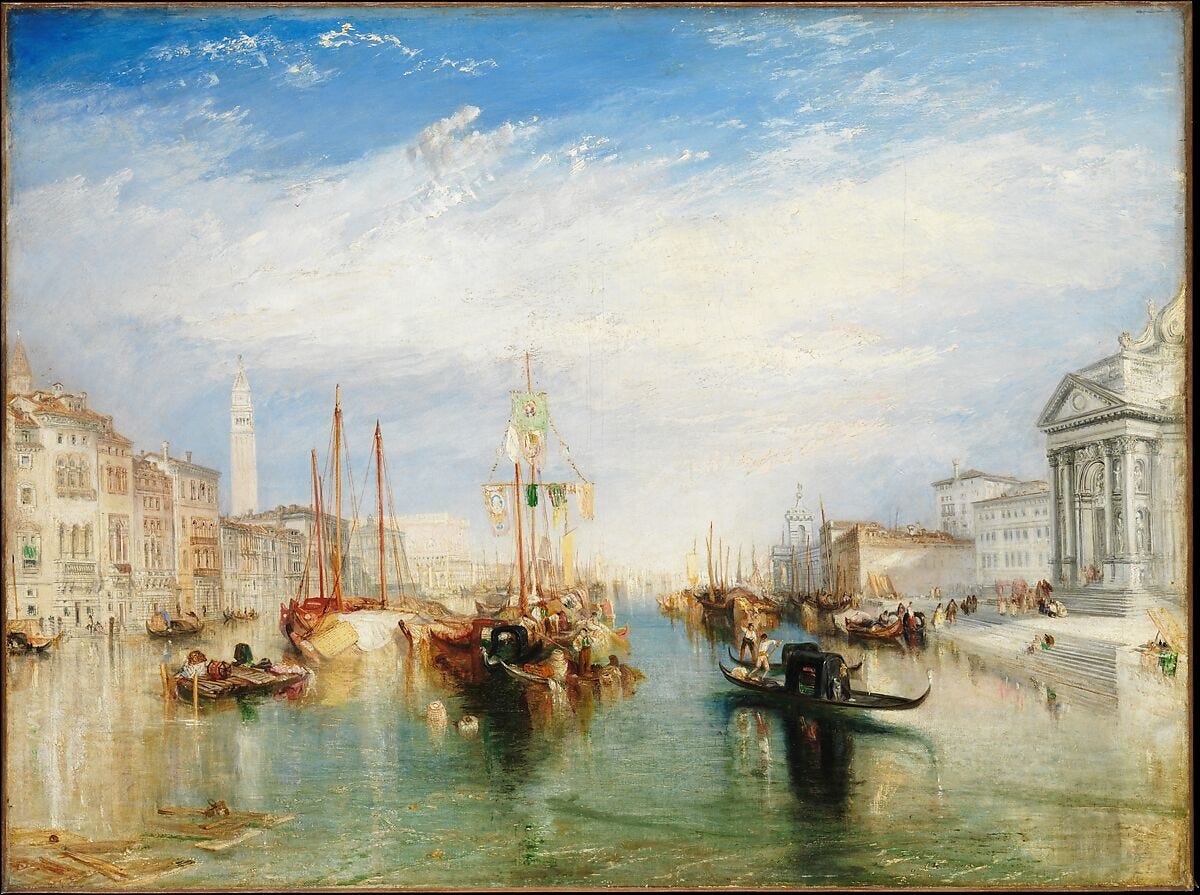
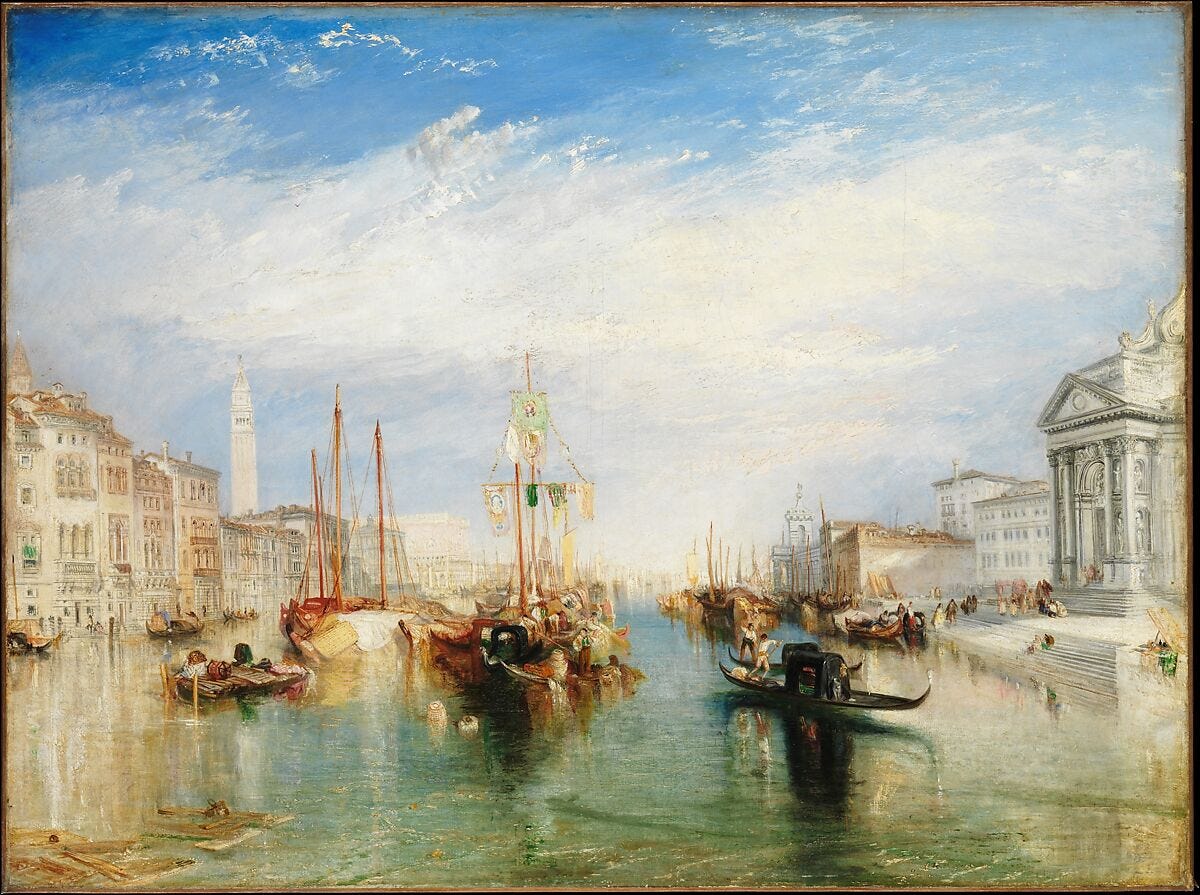
If you are VAT-registered, an export can be zero-rated, which means you charge 0% VAT. According to HMRC’s VAT Notice 703 (updated 4 March 2026), you need proof of export, and the goods must leave within three months of the sale. For a parcel sent by post, you need a customs declaration for the parcel and proof of shipment. If you are not VAT-registered, there is no VAT to charge. British painting already hangs in New York: the Metropolitan Museum of Art holds J.M.W. Turner’s view of Venice, painted around 1835.
If you sell from Italy
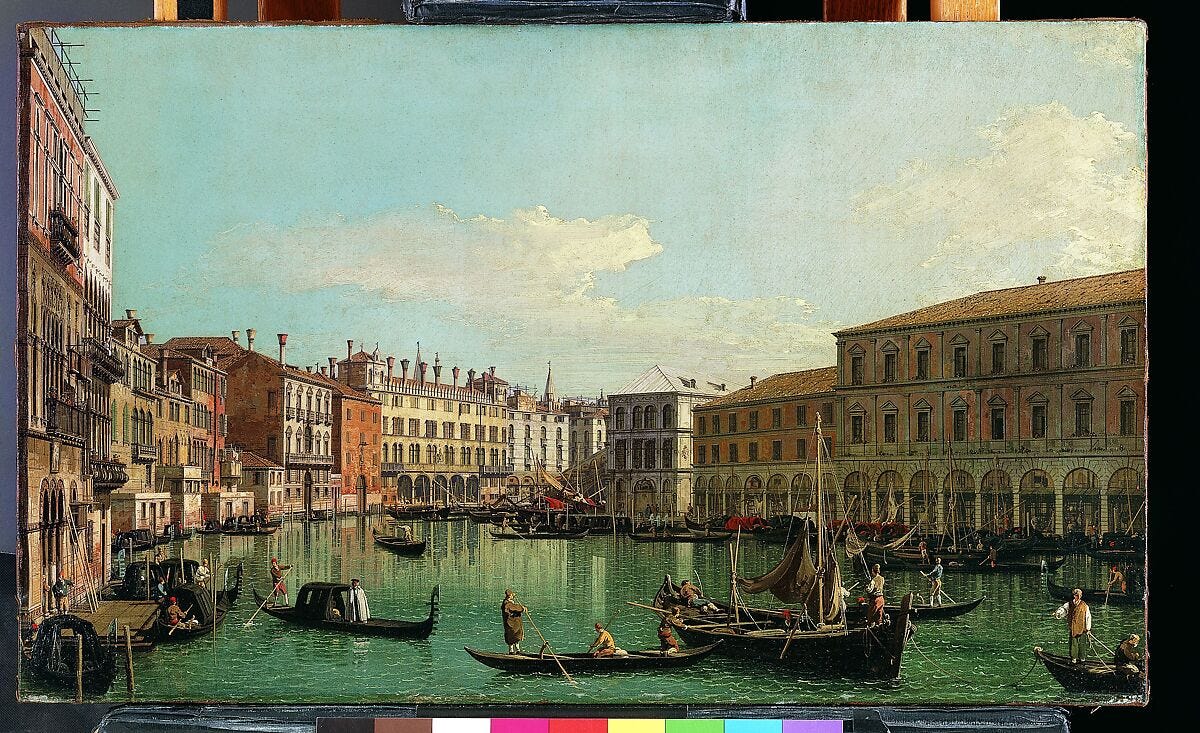
Sales of goods to buyers outside the EU are export sales under articles 8, 8-bis and 9 of DPR 633/1972. Euroconference’s tax news service reports that a taxpayer in the regime forfettario can stay in that regime when selling goods to non-EU buyers. Italian painting is in the same museum: the Met holds Canaletto’s view of the Grand Canal in Venice, painted in the 1730s.
US sales tax
It depends on the state and on how you sell, and it is not covered here. If you sell through a marketplace, the marketplace may handle it.
Pricing for a US buyer
Start with the painting, not the shipping. Our free tool gives you an estimated price range for an original painting in about 30 seconds, and it is available in the UK, the US and Italy. It is a guide to the market, not a formal appraisal. From that range, choose one price and fix it in dollars, in line with the pound or euro price you charge at home. For the factors behind a price, see how much is my painting worth.
Then add the cost of getting it there as separate lines on the invoice:
packing and the crate
shipping, and insurance for the declared value
the post or courier service fee
a broker’s fee, if you use one
Keeping these separate means the painting has the same price wherever you sell it, whether on your own site, at a fair or in a gallery. Then decide in writing who pays any duty or tax. For UK and Italian paintings it is zero at the moment, so the real risk is a rule change between the sale and the delivery. With post, the sender pays any duty at posting, so you will see it before the parcel leaves and can tell the buyer. Put that in your terms.
Last, agree who pays if the painting comes back, since a return is a second shipment.
Where the rules will move next
The US has changed these rules at least four times in nineteen months, so check four places before each shipment: the CBP guidance on informational materials, Royal Mail’s USA page or the Poste Italiane duty service page, and your broker. One date is already known: Royal Mail says enforcement of agency-specific data requirements, which was due on 22 October 2026, has been delayed to January 2027.
References
Art Basel and UBS, “The Art Basel and UBS Global Art Market Report 2026”: https://www.artbasel.com/stories/the-art-basel-and-ubs-global-art-market-report-2026
U.S. Customs and Border Protection, CSMS 69326983, “Guidance: Section 301 Forced Labor Import Duties”, 23 July 2026: https://content.govdelivery.com/accounts/USDHSCBP/bulletins/421d887
CBP, interim final rule, “Indefinite Suspension of the De Minimis Exemption for Mail Shipments and New Postal Informal Entry Process”, Federal Register, 24 June 2026 (91 FR 37801): https://www.federalregister.gov/documents/2026/06/24/2026-12669/indefinite-suspension-of-the-de-minimis-exemption-for-mail-shipments-and-new-postal-informal-entry
Renwick Fine Art Services, “U.S. Art Tariffs in 2026: Practical Advice for Importers & Shippers”, 9 May 2026, and “U.S. Art Tariffs Historical Timeline”: https://renwickfas.com/articles/us-art-tariffs-practical-advice-2026/ and https://renwickfas.com/knowledge/us-art-tariffs-timeline-2026/
Baker Donelson, “Forced Labor Section 301 Tariffs Imposed to Replace Expiring Section 122 Tariffs”, 24 July 2026: https://www.bakerdonelson.com/forced-labor-section-301-tariffs-imposed-to-replace-expiring-section-122-tariffs-what-importers-need-to-know
Tariffs Tool, HTS Chapter 97 (heading 9701 rates, checked October 2026): https://www.tariffstool.com/hts/chapter-97
World Customs Organization, Harmonized System 2022, heading 97.01 and notes: https://www.wcotradetools.org/en/harmonized-system/2022/en/21970102
Royal Mail, “Sending items to the USA”: https://www.royalmail.com/usapersonalupdates
Post Office, “Changes to USA customs requirements for imported goods”: https://www.postoffice.co.uk/vwbihpezn/mail/guides/usa-customs-requirements
Poste Italiane, “Servizio Gestione Dazi”: https://www.poste.it/servizio-gestione-dazi
The Metropolitan Museum of Art, collection records 99.31 (Turner) and 2019.141.2 (Canaletto): https://www.metmuseum.org/art/collection/search/437853 and https://www.metmuseum.org/zh/art/collection/search/438100
USDA APHIS, “Import ISPM 15-Compliant Wood Packaging Material into the United States”: https://www.aphis.usda.gov/plant-imports/wood-packaging-material/import
HMRC, “VAT on goods exported from the UK (VAT Notice 703)”, updated 4 March 2026: https://www.gov.uk/guidance/vat-on-goods-exported-from-the-uk-notice-703
Euroconference (EC News), “Le operazioni con l’estero in regime forfettario”, 13 November 2024, modified 31 December 2025: https://www.ecnews.it/fiscale/?p=14824
 Comment on Substack