War artists: how Britain commissioned painters to record conflict, from 1917 to today
In November 1917, Paul Nash wrote to his wife that he had become “a messenger who will bring back word from the men who are fighting”. He had been a soldier. Now he wanted to be something more unusual: an official war artist, commissioned to record the war.
Most of our articles on art and conflict are about artists who work on their own, often at great risk. This one is about the other tradition: painters commissioned by the state to record war. It explains how the scheme began, what it produced, and what it means for any painter who works from lived experience.
What is a war artist?
Tate defines war artists as artists commissioned through an official scheme to record the events of war. In Britain, government-sponsored schemes recorded both world wars, and the Imperial War Museum (IWM) has gone on commissioning artists for later conflicts. Tate says the work is valuable as documentation and also important as art.
The First World War: a scheme begins
According to the IWM, the first scheme began in July 1916 under Wellington House, a government propaganda department. It aimed to supply eyewitness images for publications. Among the artists commissioned were William Orpen, Paul Nash and C R W Nevinson.
In February 1918 the Ministry of Information set up the British War Memorials Committee, which planned a Hall of Remembrance covering fighting, the home front, and naval and air subjects. Artists commissioned included Percy Wyndham Lewis, Stanley Spencer and John Singer Sargent. The IWM itself was founded on 5 March 1917 to collect material documenting the war, including art. The IWM describes the planned hall as a site of pilgrimage, built around four large canvases. It was never built, because of a lack of funds, so the paintings came into the museum’s care.
Paul Nash: from soldier to war artist
Nash was posted to Ypres in early 1917 and was injured in a fall. A July 1917 exhibition of his war drawings led to his appointment as an official war artist, according to the IWM. Tate adds that at the front his letters grew bleaker.
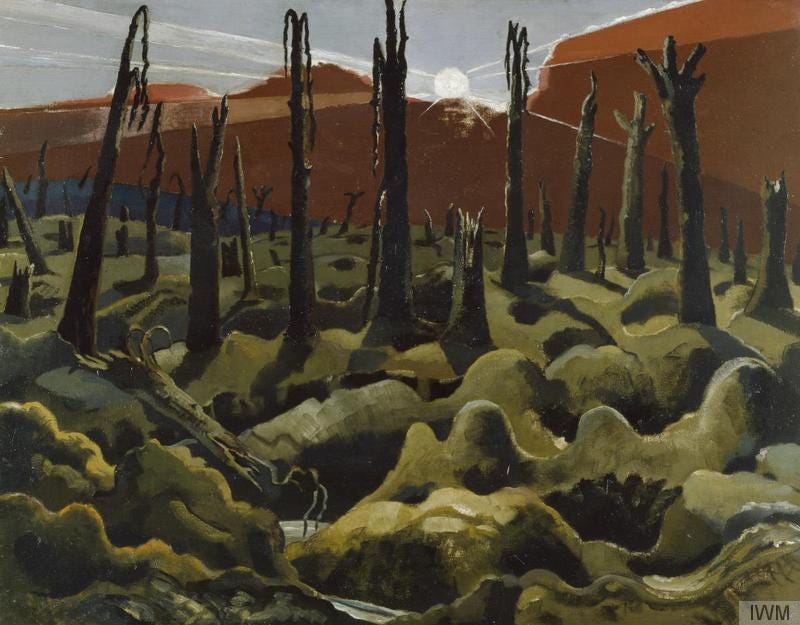
His “We Are Making a New World” (1918), now in the IWM, shows a sunrise over total devastation. Tate notes the ironic title did not appear when the picture was first published, on the cover of a book of war art. It was the most acclaimed work in his “Void of War” exhibition at the Leicester Galleries, and Tate says his pictures largely escaped censorship, partly because the censor did not grasp how they could help the enemy.
In 1919 he painted “The Menin Road” for the planned Hall of Remembrance, first titling it “A Flanders Battlefield”. When the Treasury closed the scheme, the paintings went to the IWM.
John Singer Sargent: “Gassed”
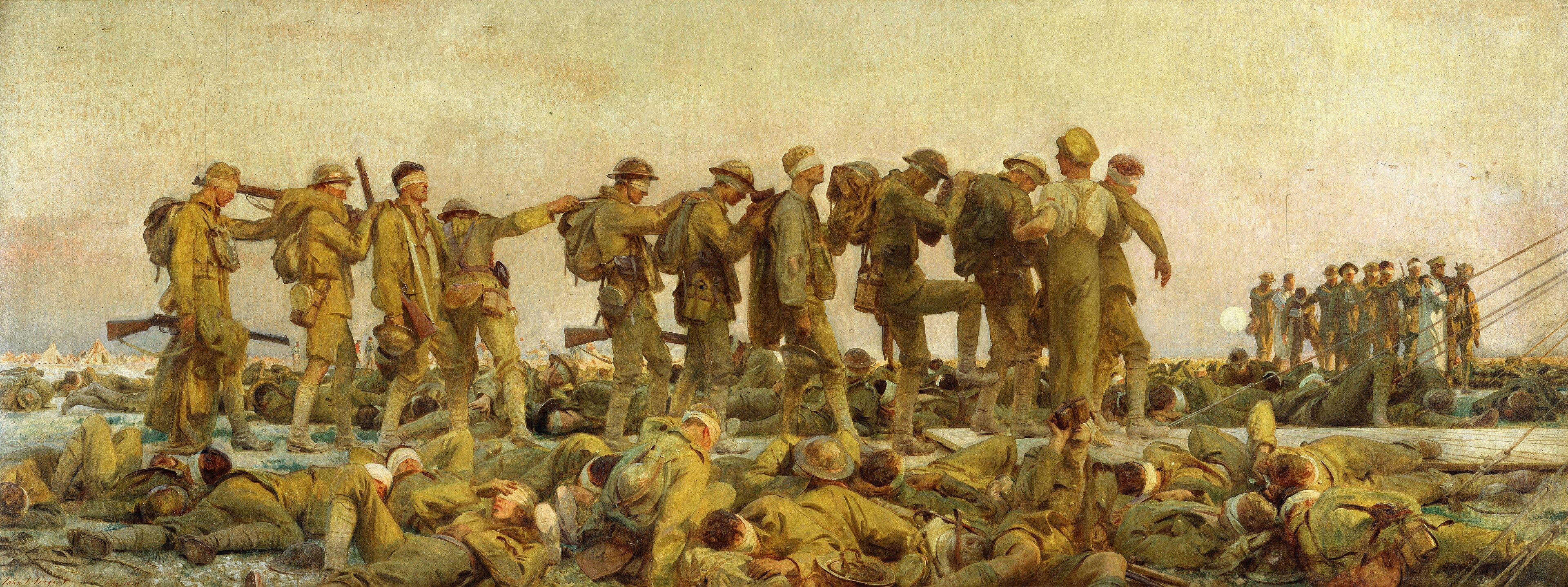
The IWM says Sargent was asked to paint Anglo-American co-operation, a theme he later dropped. He and Henry Tonks went to the Western Front in July 1918 and, in late August, saw the aftermath of a German gas attack near Arras.
“Gassed” (1919) shows a line of soldiers with bandaged eyes, each holding the shoulder of the man in front, led by an orderly. In the background a football match goes on, which the IWM says alludes to how routine such attacks were. It was meant to be the centrepiece of the Hall of Remembrance and is now the largest painting in the IWM’s collection.


The Second World War: a committee with two aims
In 1939 the Ministry of Information set up the War Artists’ Advisory Committee, prompted by Sir Kenneth Clark, then Director of the National Gallery, who chaired it. Officially its aim was propaganda: exhibitions in Britain and America to raise morale and improve Britain’s image abroad.
The IWM describes a second, less public aim. Clark’s generation had lost many artists and writers in the First World War, and keeping artists usefully employed was hoped to stop a new generation being killed. By the end of the war the committee had built a collection of 5,570 works, more than half now held by the IWM. Tate says over 300 artists were commissioned, among them John Piper, Graham Sutherland, Henry Moore, Paul Nash and Stanley Spencer.
The commissions ranged widely. The IWM calls Nash’s “Battle of Britain” (1941) an imaginative summary of RAF Fighter Command’s struggle against the Luftwaffe in 1940, more symbolic than literal. L S Lowry’s “Going to Work” was commissioned in 1943 and has been on display at IWM North since 2019. Anthony Gross, among the first artists commissioned, returned to Britain in 1944 and painted watercolours of D-Day, and Edward Ardizzone was one of the most popular and longest-serving.
Nash was fascinated by aircraft, which he called “beautiful monsters” in a 1942 article for Vogue, according to Tate. Photographs he took of wrecked German aircraft at Cowley dump fed into “Totes Meer” (1940 to 1941), the title meaning “Dead Sea”, in which he imagined the wreckage as a churning sea of dead creatures under moonlight.
Not all of them came home. The IWM notes that Eric Ravilious, Thomas Hennell and Albert Richards were killed during the war. In 1946, Tate says, one third of the collection went to the IWM and the rest was distributed to museums and galleries across the UK and Commonwealth.
Since 1945: from record to question
The IWM kept commissioning. Tate names Linda Kitson for the Falklands War, Peter Howson for the Bosnian Civil War, and Langlands & Bell for the conflict in Afghanistan. Two more recent commissions show how the idea changed.
In 2002 the IWM commissioned Paul Seawright’s “Mounds”, photographs of minefields in Afghanistan that the museum describes as both lethal and inaccessible. In 2003 it commissioned Steve McQueen, after he visited Basra, to make “Queen and Country”, an oak cabinet holding facsimile stamp sheets with portraits of British personnel who died in Iraq. The IWM says it asks about sacrifice, community and nationhood.
Not every commission looked at a current war. In 1988 the IWM’s trustees commissioned a charcoal and pencil drawing from Peter de Francia, “The Visitation”, drawing on his own four years of army service in the Second World War and concerned with soldiers and mortality. The museum’s collection also holds Jock McFadyen’s oil and collage “With Singing Hearts and Throaty Roarings”, which responds to the Falklands War and which the IWM describes as critical of the surge in bombastic patriotism.
Neither Seawright’s nor McQueen’s work is a painting, and the IWM does not call either artist an official war artist; they are artists it commissioned to respond to those conflicts. But the pattern is clear. The brief moved from recording events to questioning them.
What this means if you paint
Most painters will never be commissioned by a museum, but three habits from these artists carry over to anyone working from lived experience.
Be a witness, with dates. Nash and Sargent painted what they had seen, and the records of when and where are part of why the works matter. Keep dated notes, sketches and photographs for every series.
Know where your work will live. The war artists’ pictures survive because institutions collected and documented them. A clear record of your own work, with titles, sizes, mediums and sales, does the same job at your scale.
Reputation is built, not given. A commission or a public collection raises how a painter is seen. Our article on why artist reputation drives painting prices explains how.
If you paint from experience, whether war, memory or place, and want a starting price range for an original painting, our free tool gives you one in about 30 seconds. It is a guide to the market, not a formal appraisal.
Where to go next
The full picture: read how artists are responding to war, our guide to painting as documentation, protest and survival.
Censorship and loss: see censorship, destroyed works and survival.
Remembering: read art and memory: how painters document what the world wants to forget.
The market: see the market for conflict art.
References
Tate, “War artists”: https://www.tate.org.uk/art/art-terms/w/war-artists
Imperial War Museum, “How the British government sponsored the arts in the First World War”: https://iwm.org.uk/history/how-the-british-government-sponsored-the-arts-in-the-first-world-war
Imperial War Museum, “Gassed by John Singer Sargent”: https://www.iwm.org.uk/history/first-world-war/remembrance/gassed-john-singer-sargent
Tate, “The Archival Trail: Paul Nash the war artist”: https://www.tate.org.uk/art/artists/paul-nash-1690/paul-nash-war-artist
Imperial War Museum, “The secret purpose of the War Artists Advisory Committee”: https://www.iwm.org.uk/history/the-secret-purpose-of-the-war-artists-advisory-committee
Imperial War Museum, “8 powerful works from our contemporary art collection”: https://www.iwm.org.uk/history/8-powerful-works-from-our-contemporary-art-collection
Made with love by artists, for artists 🫶🏼
info@priceyourpainting.com | www.priceyourpainting.com | Instagram