In this article (6 sections)
New York’s November auctions ended on 19 November with a total of about $2.8 billion across five major sales, according to Ocula’s round-up, published on 20 November. Behind that headline, the week was more selective than the total suggests. Here is what sold, what struggled, and what the week can and cannot tell painters working at a much smaller scale.
The week in numbers
Two figures describe the week, and they measure different things. Ocula counts five sales with buyer’s fees included: Sotheby’s Wednesday evening on 18 November reached $777.8 million, the house’s highest total for a single night, Christie’s 20th Century Evening Sale on 17 November reached $627 million, and Christie’s 21st Century Evening Auction on 19 November reached $146 million.
MyArtBroker looks at hammer prices, without fees, and at eight core modern and contemporary sales. It puts them at about $1.12 billion, roughly 30% above last year. For the four evening sales of Christie’s, Sotheby’s and Phillips it gives about $949 million, around 3% below the combined low estimates.
The detail shows a selective room. In those evening sales, about a quarter of the lots sold above their high estimate, 31% hammered below their low estimate, and 11% went unsold. Guarantees covered roughly half or more of the lots in three of the four evening auctions.
A Van Gogh at $190.4 million
The top lot was Vincent van Gogh's Châtaigniers en fleurs (Blossoming Chestnut Trees, 1890), sold by Sotheby's on 18 November for $190.4 million with fees, or $165 million at the hammer, against an estimate of around $180 million. According to The Art Newspaper, it passed the artist's previous auction record of $117 million, set in 2022 at Christie's Paul Allen sale, and the buyer was William Acquavella of Acquavella Galleries, who bid in the room.
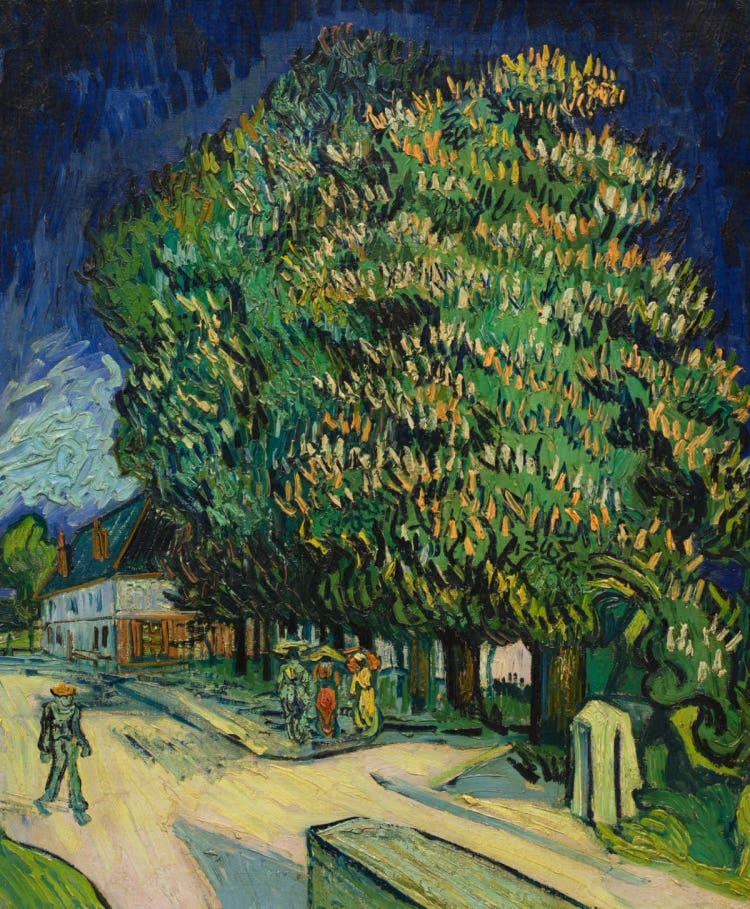
This is a different painting. It shows Irises, a Van Gogh from the same year that hangs in the Metropolitan Museum of Art, and it is included here to show the artist’s work from 1890, not the lot that sold.
Klimt and Kandinsky at Christie’s, Magritte at Sotheby’s
On 17 November Christie’s sold Wassily Kandinsky’s Betonte Ecken for $85.8 million, against an estimate of $60 to $80 million, and Gustav Klimt’s Litzlbergkeller for $82.3 million, against the same estimate range. Both hammered inside that range, at $74 million and $71 million, and the totals include fees.
Among the other top lots, Sotheby’s sold René Magritte’s L’Ami de l’ordre on 18 November for $45.5 million against an estimate of $25 to $35 million, while Christie’s sold Jean-Michel Basquiat’s Untitled (Leonardo and His Five Grotesque Heads) on 19 November for $32.9 million against an estimate of $30 to $50 million, inside its range. At Phillips on 17 November, Modigliani’s Tête made up 45% of the sale’s hammer total, and David Hockney’s David, Celia, Stephen and Ian, London 1982 sold for $10 million, at the bottom of its estimate range, according to MyArtBroker.
Where the surprises were
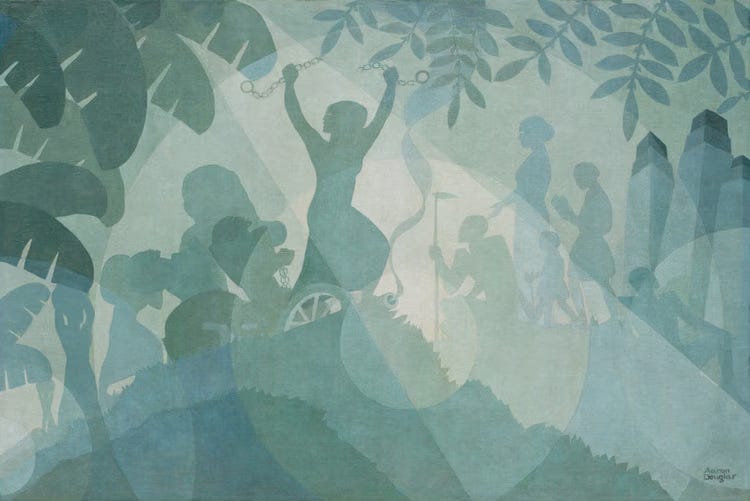
Prices far below the top lots carried the more useful information. Aaron Douglas’s Harriet Tubman (1931) sold at Sotheby’s for $14.5 million with fees against a high estimate of $3.5 million, a record for the artist, according to Ocula and The Art Newspaper. Mary Cassatt’s Summertime made $13.3 million with fees, beating her previous record of $7.49 million, according to The Art Newspaper.
Lower down, a canvas by Julia Jo, One Fell Swoop (2026), sold at Christie’s for $409,600 against an estimate of $30,000 to $50,000, also an artist record. Artsy’s list of 20 new artist records from the week reaches further, with Tomma Abts at $281,600 at Sotheby’s, Alvaro Barrington at $129,000 at Phillips, and Sofía Bassi at $121,600 at Sotheby’s.
What a week like this can tell a painter
Very little about price, and some about attention. The sources we read give no figures for new paintings under $100,000, and none for artists at the start of a career. What they do show is that bidders in New York paid well above estimate for a few works they wanted and below estimate for many they were merely offered, so the market is rewarding a small set of specific works, not a rising tide.
For a painter pricing their own work, the useful lesson is the same one the auction room teaches: a price is a claim that has to be backed by evidence. How to determine the right price for your artwork explains how to build one, how much is my painting worth: 5 factors covers what moves it, and where to sell your paintings in 2026 compares the routes to a buyer. For how valuation moved from the dealer’s eye to something you can check, see the history of painting estimation.
References
Ocula Magazine, “All You Need to Know About New York’s $2.8bn Marquee Week Sales”, 20 November 2026: https://ocula.com/magazine/art-news/new-yorks-28bn-marquee-week-sales-roundup/
MyArtBroker, “New York November Auctions 2026: Bigger Totals, More Selective Bidding”, last updated 22 November 2026: https://www.myartbroker.com/investing/articles/new-york-november-auctions-2026
Artsy, “20 New Artist Auction Records Set in November 2026”, 20 November 2026: https://www.artsy.net/article/artsy-editorial-20-new-artist-auction-records-set-november-2026
The Metropolitan Museum of Art, collection records 58.187 (Van Gogh) and 64.148 (Klimt): https://www.metmuseum.org/art/collection/search/436528 and https://www.metmuseum.org/art/collection/search/436819
 Comment on Substack